
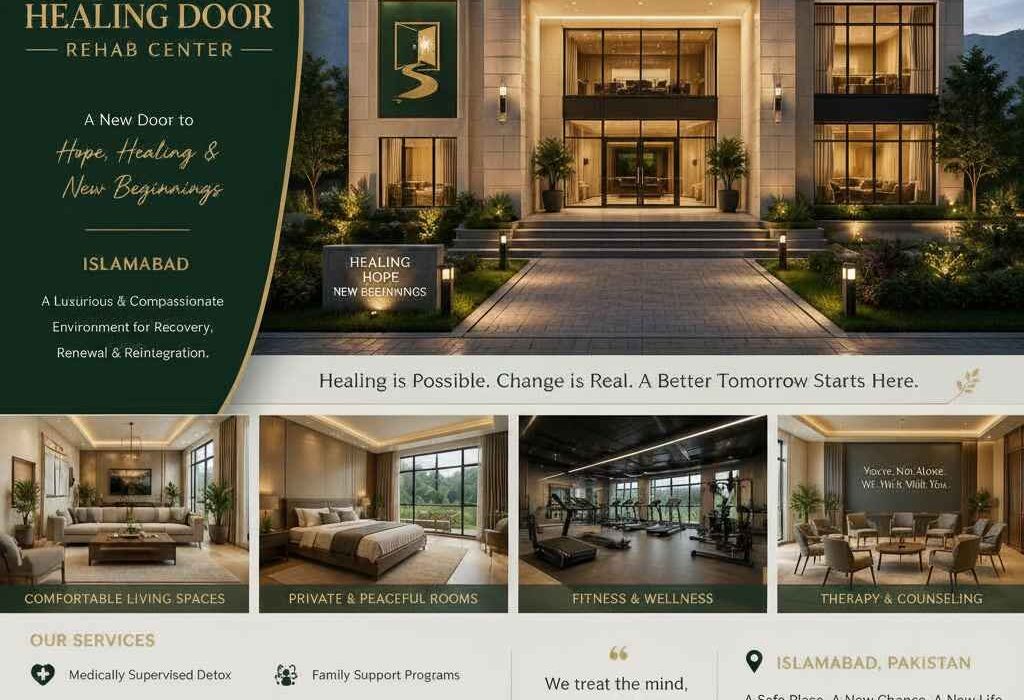
Luxury Rehab Center in Bani Gala Islamabad (2026 Guide)
Picking a rehab center in Bani Gala Islamabad is rarely a calm, researched decision. Usually it’s a family in crisis, googling at 1 a.m., trying to figure out if “luxury” means better treatment or just a nicer waiting room. That distinction matters more than most websites admit. A best rehabilitation center Islamabad families actually recommend afterward is judged on clinical outcomes and staff-to-patient ratio, not marble floors. This guide walks through what separates a genuinely effective facility from one that’s simply well-photographed, so you can make a decision you won’t need to reverse in six months.
What “Luxury” Should Mean in Addiction Treatment
A luxury drug rehabilitation center is one that combines medically supervised detox, licensed clinical staff, and private accommodation — not one that simply charges more. In Pakistan’s growing private treatment sector, the word “luxury” gets attached to almost any facility with air conditioning and a garden view. That’s a marketing shortcut, not a clinical standard.
The real differentiator is staffing. A facility with one psychiatrist visiting twice a week and a handful of untrained attendants is not a premium addiction treatment center, regardless of what the brochure looks like. In our review of similar private facilities across Islamabad and Lahore, the ones with consistently better relapse-prevention outcomes shared three traits: a resident (not visiting) psychiatrist, a structured 90-day minimum program, and family therapy built into the plan rather than sold as an add-on.
Why Bani Gala Specifically
Bani Gala’s appeal for treatment facilities is practical, not cosmetic. Its distance from central Islamabad and the Margalla Hills backdrop give it two things clinical programs actually need: reduced access to the patient’s old social triggers, and enough land for residential-style campuses rather than converted apartment blocks. Several private treatment providers have set up here specifically because the zoning allows larger, walled compounds — a genuine requirement for secure inpatient care, not a luxury flourish.
That said, location alone doesn’t guarantee quality. A scenic property with a weak clinical team will underperform a modest facility with strong medical supervision every time.
Who Actually Needs Inpatient Rehab vs. Outpatient Support
This is the question most rehab-center websites skip entirely, and it’s the one that determines whether you’re about to spend money on the wrong level of care.
Inpatient (residential) treatment is appropriate when there’s physical dependence requiring medical detox — opioids, alcohol, or benzodiazepines — where withdrawal carries real medical risk. Outpatient or intensive outpatient programs suit people with psychological dependence, earlier-stage use, or those who cannot leave work or family responsibilities for 60–90 days.
The gap most articles miss: what happens when a family can’t afford or access inpatient care but the addiction is severe. In that scenario, the honest answer is a stepped approach — medical detox at a hospital (cheaper, shorter, government or teaching hospitals in Islamabad and Rawalpindi offer this), followed by outpatient counseling at a lower-cost facility. It’s not the ideal path, but it’s clinically defensible and far better than no treatment.
Best Luxury Rehab Center in Pakistan: How to Actually Compare Options
There’s no single “best luxury rehab center in Pakistan” — the right one depends on substance type, budget, and whether the patient has co-occurring mental health conditions. Here’s a framework to evaluate any facility you’re considering, whether in Bani Gala, Lahore, or Karachi.
| Evaluation Factor | What to Ask | Red Flag Answer |
|---|---|---|
| Medical staffing | Is there a resident psychiatrist or only visiting consultants? | “Visits twice a week” |
| Program length | What’s the minimum program duration? | Under 21 days for substance dependence |
| Detox protocol | Is detox medically supervised on-site? | Detox handled off-site or unsupervised |
| Aftercare | Is there a structured aftercare/relapse-prevention plan? | “We’ll refer you elsewhere after discharge” |
| Family involvement | Is family therapy included or extra-cost? | Not offered at all |
| Licensing | Is the facility registered with a health authority? | No clear licensing information |
If a facility can’t answer the licensing question directly, that’s disqualifying — not a minor concern.
Affordable Luxury Rehab Islamabad: Is That a Real Category?
Yes, and it’s a legitimate middle tier most people don’t know to ask for. Affordable luxury rehab Islamabad typically means shared or semi-private rooms instead of single suites, group therapy as the primary modality with individual sessions added selectively, and a 30–45 day program instead of 90. Clinically, this tier can produce comparable outcomes to full-luxury programs for patients without complex co-occurring conditions — the difference is largely comfort, not medical efficacy.
For a mid-size family business owner in Islamabad managing a relative’s alcohol dependence, this tier is often the more rational choice than paying for a 90-day single-suite program that exceeds what the clinical picture requires.
Cost Reality: What Rehab Actually Costs in Pakistan (2026)
Pricing varies enough by facility that any single number is misleading. What’s more useful is understanding the cost structure.
| Program Type | Typical Duration | Cost Driver |
|---|---|---|
| Government/teaching hospital detox | 7–14 days | Lowest cost; limited privacy, no residential aftercare |
| Mid-tier private rehab | 30–45 days | Shared rooms, group-heavy therapy |
| Premium/luxury private rehab (Bani Gala-type) | 60–90 days | Private rooms, resident psychiatrist, individualized therapy, family program |
| Extended/relapse-recovery programs | 90+ days | Complex co-occurring cases, repeat admissions |
Total cost of care isn’t just the program fee. Factor in lost income during treatment, ongoing outpatient counseling after discharge (commonly 6–12 months), and the real possibility of a second admission — industry data from international relapse studies consistently shows first-attempt success rates below 50% for substance dependence, which is why aftercare budget matters as much as the initial program fee. Always confirm current pricing, inclusions, and payment terms directly with the facility, since packages change and vary by patient needs.
Common Mistakes Families Make When Choosing a Facility
- Choosing based on photos, not staff credentials. A well-landscaped property says nothing about clinical competence.
- Skipping the licensing check. Ask which health authority regulates the facility and confirm it independently.
- Underestimating aftercare. Treatment that ends at discharge with no follow-up plan has a much higher relapse rate.
- Ignoring co-occurring mental health conditions. Depression, anxiety, or trauma alongside substance use needs dual-diagnosis capability, not a standard program.
- Assuming higher price means better outcome. It often means better amenities. Ask the outcome question directly.
Pros and Cons: Private Luxury Rehab vs. Public/Low-Cost Treatment
Private luxury rehab (Bani Gala-type facilities)
- Privacy and discretion, important for professionals and public-facing families
- Lower staff-to-patient ratio, more individualized therapy
- Higher cost, and quality still varies facility to facility
Public or low-cost treatment centers
- Far more affordable, sometimes free through government programs
- Often better medical detox infrastructure due to hospital affiliation
- Less privacy, longer wait times, minimal aftercare structure
Neither option is universally “better.” The right choice depends on the substance involved, financial capacity, and how much privacy the family genuinely needs.
What Changes at Scale: Individual, Corporate, and Family-Referral Cases
For a single individual seeking treatment, the decision is mostly about fit and budget. For corporate referrals — companies in Islamabad’s private sector increasingly include rehab coverage in executive health benefits — the calculation shifts toward facilities with confidentiality agreements and flexible scheduling around return-to-work timelines. For families managing multiple members with substance issues (not uncommon in cases involving shared trauma or enabling dynamics), facilities offering concurrent multi-family therapy tracks perform noticeably better than sending each person through a separate, disconnected program.
Before deciding, it’s worth auditing what your specific situation actually requires — substance type, medical risk during withdrawal, and budget — rather than starting from a list of “top rehab centers” and working backward.
FAQ
1. What is the difference between a rehab center and a rehabilitation center?
There isn’t a clinical difference — both terms describe facilities providing structured treatment for substance dependence. “Rehab center” is the informal term; “rehabilitation center” is more common in formal or medical contexts. Some rehabilitation centers also treat non-addiction conditions like physical injury, so confirm the facility specializes in substance use before enrolling.
2. How long does luxury rehab treatment typically take in Islamabad?
Most premium facilities in and around Islamabad run 60- to 90-day residential programs. Shorter 30-day programs exist but are generally better suited to earlier-stage dependence without complex withdrawal risk. Duration should match the substance and severity, not a fixed marketing package.
3. Is inpatient rehab necessary for every type of addiction?
No. Inpatient care is medically necessary mainly for substances with dangerous withdrawal profiles — alcohol, opioids, and benzodiazepines. Many other cases respond well to intensive outpatient programs, especially when there’s no physical dependence and the patient has stable home support.
4. How much does a luxury rehab center in Bani Gala cost?
Costs vary widely by program length, room type, and services included, so there’s no single reliable figure. Expect premium 60–90 day residential programs to sit well above mid-tier private options. Always confirm current pricing directly with the facility rather than relying on third-party estimates.
5. What should I check before trusting a rehab center’s licensing claims?
Ask which health authority or regulatory body oversees the facility and request documentation. A legitimate facility will provide this without hesitation. If licensing information is vague or unavailable, treat that as a serious warning sign.
6. Does insurance cover rehab treatment in Pakistan?
Coverage is inconsistent and depends entirely on the specific insurer and policy. Some corporate health plans in Pakistan now include mental health and addiction treatment riders, but this is far from universal. Confirm directly with your insurer before assuming coverage.
7. What’s the success rate of rehab programs?
Success rates vary by substance, program quality, and how “success” is defined (abstinence at discharge vs. at one year). International addiction research generally shows first-attempt long-term success rates below 50%, which is why structured aftercare after discharge matters as much as the program itself.
8. Can family members visit during residential treatment?
Most structured programs restrict visits during an initial stabilization period, then integrate scheduled family therapy sessions as part of the program. Facilities that allow unrestricted visitation from day one are often prioritizing comfort over clinical structure.
9. What happens after the rehab program ends?
Reputable facilities provide a structured aftercare plan — outpatient counseling, support groups, and relapse-prevention check-ins for 6 to 12 months post-discharge. A program that ends abruptly at checkout with no follow-up plan carries a materially higher relapse risk.
10. Are there affordable alternatives to luxury rehab in Islamabad?
Yes. Government and teaching hospitals offer medically supervised detox at a fraction of private rehab costs, and several mid-tier private facilities offer semi-private, group-therapy-focused programs. These can be clinically appropriate for patients without complex co-occurring conditions.
Conclusion
The right rehab center in Bani Gala Islamabad isn’t the one with the best photos — it’s the one whose staffing, licensing, and aftercare structure match the specific case in front of you. Luxury amenities can support recovery, but they don’t replace a resident psychiatrist, a medically supervised detox protocol, or a real follow-up plan after discharge. Before contacting any facility, write down the substance involved, the withdrawal risk, and your actual budget ceiling — that list will tell you more than any ranking article. Treatment that works is treatment that fits the person, not the brochure.