Luxury Rehabilitation Center in Islamabad | HDRC Bani Gala 2026
Families searching for a luxury rehabilitation center in Islamabad are rarely doing so casually. Someone they love is in crisis, the situation has probably been building for months, and the decision now carries enormous stakes. The question is not whether to get help. The question is which facility is actually worth trusting with that help.
This guide breaks down what separates a genuinely high-standard rehab center from one that simply uses premium language to justify higher fees. It covers what luxury rehab looks like in the Islamabad context, what clinical standards actually matter, what questions to ask before committing, and why location inside Bani Gala plays a bigger role in recovery outcomes than most people expect.
What “Luxury Rehab” Actually Means in the Islamabad Context
The word luxury gets attached to a lot of facilities. Not all of them earn it. In the Islamabad rehabilitation market, the term typically gets used to signal private rooms, better food, and quieter surroundings. Those things matter, but they are not the whole picture.
A genuine luxury rehabilitation center delivers something more specific: a lower patient-to-staff ratio, which means more individualized clinical attention per person; dual-diagnosis capability, meaning the facility can treat addiction and underlying mental health conditions at the same time rather than sequentially; verified regulatory accreditation, not just self-declared; and an environment that actively supports recovery rather than simply removing the person from their home environment.
Accreditation is the clearest objective marker. In Pakistan’s rehabilitation sector, IHRA (Islamabad Healthcare Regulatory Authority) registration sets the minimum clinical standard for staff credentials, facility safety, and documentation. UNODC (United Nations Office on Drugs and Crime) accreditation goes further, reflecting internationally evaluated treatment methodology. If a center cannot show both, the word luxury is marketing, not a clinical descriptor.
Healing Door Rehab Center (HDRC) in Bani Gala, Islamabad holds both UNODC accreditation and IHRA approval, and has operated with 10 or more years of continuous clinical experience in addiction treatment, psychiatric care, and mental health rehabilitation.
Why Bani Gala Is Not Just a Location Detail
Most people searching for a VIP rehab center in Bani Gala, Islamabad understand the geography, but fewer understand why it matters clinically.
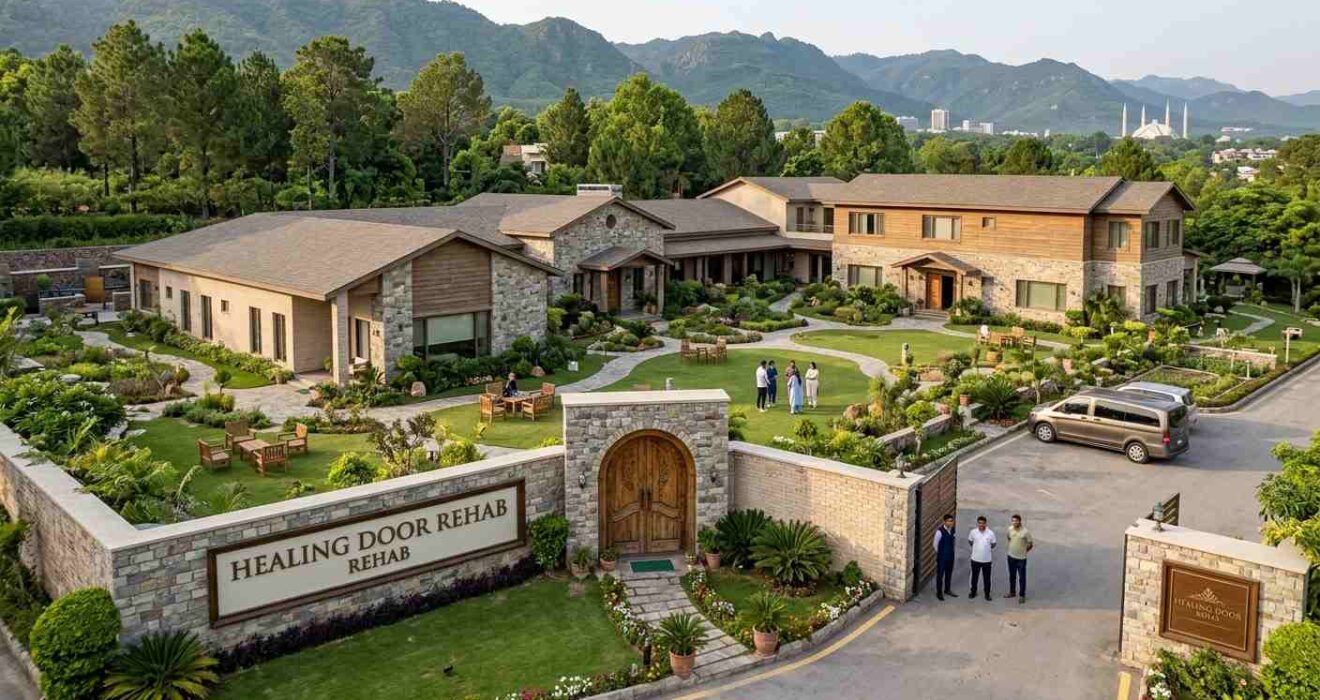
Recovery research has consistently shown that environmental separation from familiar addiction triggers is a meaningful early-stage intervention in its own right. Bani Gala sits away from the urban density of central Islamabad and Rawalpindi, surrounded by greenery and natural quiet. That physical distance from social networks associated with substance use is not just comfort. It is a deliberate structural support for the early weeks of recovery, which remain the most vulnerable phase in any treatment program.
Centers located in dense urban settings have to compensate for this through tighter internal structure. Bani Gala facilities do not carry that burden in the same way. The setting does part of the therapeutic work.
HDRC’s facility sits opposite Mezan Bank on Main Jinnah Road in Bani Gala. Patients coming from DHA, F-series sectors, or any part of Rawalpindi can reach it within a manageable drive. More importantly, they can stay there in an environment that does not constantly remind them of the world they are trying to recover from.
The Clinical Services That Separate HDRC From a Standard Facility
Treatment quality at any rehabilitation center comes down to what it can actually treat, who is treating it, and whether those people are qualified to manage complexity.
What HDRC Treats
HDRC offers a broad spectrum of services that covers the full range of cases a family in Islamabad is likely to face:
- Drug addiction treatment using CBT (Cognitive Behavioral Therapy), group therapy, and individualized recovery planning
- Medically supervised detoxification with 24/7 oversight during the withdrawal phase
- Alcohol abuse treatment with relapse prevention protocols
- ICE (crystal methamphetamine) rehabilitation, a service explicitly relevant to Pakistan’s rapidly growing methamphetamine use crisis
- Psychiatric services for anxiety, depression, schizophrenia, PTSD, and personality disorders
- Female-only rehabilitation in a private, all-female support environment
- An in-house medical clinic for ongoing healthcare during residential treatment
- A dedicated mental health and psychiatric clinic for mood disorders, trauma, and psychosis
The inclusion of ICE rehabilitation is notable. Pakistan has seen a documented sharp increase in methamphetamine use among younger adults since 2022, according to a 2024 UNODC Pakistan country assessment. Many rehabilitation centers are not equipped to manage the specific psychiatric complications of ICE addiction, which can include drug-induced psychosis, severe sleep disruption, and intense psychological dependency. A center that lists ICE rehabilitation as a service without a qualified psychiatric team behind it is taking a clinical risk with the patient.
At HDRC, that psychiatric coverage exists. The team includes a Consultant Psychiatrist and Psychotherapist (Prof Dr Jan Alam), an MBBS-qualified physician with specialist addiction training (Dr Shahid Ikram), clinical psychologists, addiction specialists, and a CEO who is himself a Consultant Psychologist and Addiction Therapist. That depth of credential matters, and it is directly relevant when a case involves dual diagnosis.
What Dual Diagnosis Means and Why It Matters Here
Dual diagnosis is when a person has both a substance use disorder and a co-occurring mental health condition. Depression and addiction together. Anxiety and alcohol dependence. ICE use and psychosis. These are not two separate problems that can be treated in sequence. They feed each other. Treating one while ignoring the other almost always leads to relapse.
In the Islamabad rehabilitation context, many facilities can manage a straightforward detox. Fewer have the psychiatric capacity to handle a patient whose addiction is layered with undiagnosed depression, PTSD from trauma, or a personality disorder. HDRC’s psychiatric team covers that capacity.
What Families Actually Want to Know Before Choosing
The decision to admit a family member to a residential rehabilitation center is one of the most difficult ones a family makes. The questions families ask are almost never the ones featured prominently on a facility’s homepage.
Here is what actually matters:
| Question | What to Ask the Facility |
|---|---|
| Who will oversee my family member’s care day to day? | Ask for the name and qualification of the primary treating clinician. |
| What is the patient-to-staff ratio? | More staff per patient means more individualized attention during high-risk moments. |
| Is the facility IHRA-registered and UNODC-accredited? | Request documentation. Any credible facility provides it without hesitation. |
| Can you treat a co-occurring mental health condition alongside addiction? | This is the dual diagnosis question. The answer tells you whether the facility is genuinely equipped for complex cases. |
| What happens after discharge? | Aftercare planning is where most programs fail. A 90-day residential program without structured aftercare has a much higher relapse rate. |
| Is family involvement part of the program? | Recovery is almost never an individual event. Facilities that exclude family from the process are missing a clinically significant support mechanism. |
HDRC offers comprehensive aftercare planning post-discharge, family involvement in the treatment process, and individual treatment plans built around the specific case rather than a standard package applied to every patient.
The Honest Trade-Off: What Luxury Rehab Cannot Guarantee
No rehabilitation center, regardless of accreditation level or facility quality, can guarantee recovery. This is worth stating plainly because some facilities imply otherwise.
What a high-quality center with proper clinical staff and the right environment can do is substantially increase the probability of successful recovery. The structure removes daily access to substances. The clinical team addresses underlying conditions that drive use. The therapeutic programs build the coping mechanisms that relapse prevention depends on. And aftercare extends that support into the period after discharge, which is consistently identified as the highest-risk window.
Recovery is a long-term outcome, not an event. A 90-day residential program at the best facility in Islamabad is a foundation. What happens in the 12 months after discharge depends significantly on aftercare quality, family environment, and the patient’s own engagement with the process.
If you are evaluating HDRC or any other VIP rehab center in Bani Gala, ask specifically about the aftercare structure. What does ongoing support look like after the residential phase ends? Is there outpatient follow-up? Family sessions? A relapse protocol? Facilities that give vague answers here deserve more scrutiny.
How to Compare Rehab Centers in Islamabad Without Getting Lost in Marketing
The Islamabad rehabilitation sector has grown significantly in the last few years. As of 2026, Bani Gala alone has multiple residential facilities competing for the same search terms. Some of that competition is good, because it has pushed clinical standards upward across the sector. Some of it has produced facilities with impressive websites and weak clinical depth.
A structured comparison is more useful than reading testimonials.
| Factor | What Genuinely Matters |
|---|---|
| Regulatory status | IHRA-registered and UNODC-accredited carries real weight. Self-declared credentials do not. |
| Years of operation | Longer track records in a specific market matter. Newer facilities may be excellent; they have less evidence. |
| Team credentials | Verify the actual qualifications of the treating psychiatrist and psychologists, not just their titles. |
| Service range | Facilities that can treat psychiatric co-morbidities alongside addiction are clinically more capable for complex cases. |
| Program duration | Effective residential programs run 90 to 120 days for moderate to severe cases. Shorter programs are appropriate for milder presentations. |
| Aftercare clarity | Ask what happens on day 91. A credible facility has a clear answer. |
| Family involvement | Programs that include family in the process have better long-term outcomes. |
HDRC’s standard residential program runs 90 to 120 days. Program length and pricing should be verified directly with the admissions team, as individual cases vary and pricing changes over time. Contact HDRC at +92 314 992 2547 or reach out via the website at healingdoorrehab.com to get current details.
The One Segment Most Articles on This Topic Ignore
Overseas Pakistanis and returning diaspora represent a growing share of families searching for luxury rehab centers in Islamabad. A person who has been living in the UK, Canada, the Gulf, or elsewhere and is dealing with an addiction problem, or whose family member back in Pakistan is, faces a specific set of concerns that most local facilities are not addressing in their content.
Those concerns include: how confidential is treatment given social networks in Islamabad; will the family back home know; is the clinical standard comparable to what would be available abroad; is communication with the patient possible during the program; and how is the transition managed if the patient needs to return internationally after treatment.
HDRC’s facility operates in a confidential environment and offers 24/7 support with direct communication lines. Families outside Pakistan can reach the admissions team directly on +92 314 992 2547. The center’s track record in handling complex, culturally sensitive cases is reflected in its 10-plus years of continuous operation and its UNODC accreditation, which applies internationally recognized standards.
Taking the First Step: What the Process Actually Looks Like
Families who contact HDRC for the first time often do not know exactly what they are asking for. They know there is a problem. They do not always know what the right level of care looks like, whether residential or outpatient treatment is appropriate, or how to handle the logistics.
The process at HDRC is straightforward:
- Contact the admissions team directly by phone or WhatsApp at +92 314 992 2547, available 24 hours a day, 7 days a week.
- An initial consultation covers the presenting situation, substance use history, any mental health history, and what the family’s specific concerns are.
- The clinical team assesses which level of care is appropriate: detox only, residential rehabilitation, outpatient, or a combination.
- An individualized treatment plan is built from that assessment.
- Admission is arranged at a time that works for the family and the patient.
The location in Bani Gala is accessible from central Islamabad and Rawalpindi. If you want to visit the facility before committing to admission, HDRC encourages it. Seeing the environment, meeting the team, and understanding the program before a formal admission gives families the confidence the decision deserves.
Conclusion
Choosing a luxury rehabilitation center in Islamabad is not a decision that should rest on a website’s photography or its search ranking. It should rest on regulatory accreditation you can verify, clinical credentials you can confirm, a program structure that matches the specific case, and an aftercare plan that takes the work beyond discharge.
HDRC in Bani Gala brings 10-plus years of clinical experience, UNODC accreditation, IHRA approval, a multi-disciplinary specialist team, and a setting that actively supports early recovery. That combination is not common in the Islamabad market.
If someone you care about needs help now, the right next step is a direct conversation. Call +92 314 992 2547 at any time. Recovery does not wait for a convenient moment. Neither should the first call.
FAQ SECTION
1. What is the difference between a luxury rehab center and a standard rehab center in Islamabad?
A luxury or VIP rehabilitation center provides a lower patient-to-staff ratio, more individualized clinical attention, private accommodation, better nutritional support, and typically a broader range of therapeutic services including dual-diagnosis psychiatric care. The key distinction is not comfort. It is clinical depth. A facility with premium surroundings but weak psychiatric credentials is not meaningfully superior. Look for UNODC accreditation and IHRA registration as the baseline for any credible facility, luxury or otherwise.
2. How long does residential rehabilitation treatment take at HDRC?
HDRC’s standard residential program runs between 90 and 120 days, depending on the individual case. Shorter timelines of 30 or 60 days may be appropriate for less severe presentations, while complex dual-diagnosis cases or long-term poly-substance use may require longer stays. The admissions team will assess the specific situation and recommend the appropriate duration. Always verify current program structures directly with the facility, as these can change.
3. Can women get separate, private rehabilitation treatment at HDRC?
Yes. HDRC operates a dedicated female rehabilitation program in a private, women-only environment with an all-female support team. This matters significantly in the Pakistani context, where cultural barriers and privacy concerns are often what delay families from seeking treatment for female family members. The program covers drug and alcohol addiction as well as mental health conditions within a setting designed specifically around those concerns.
4. What is dual diagnosis and does HDRC treat it?
Dual diagnosis refers to the presence of both a substance use disorder and a co-occurring mental health condition, such as depression combined with alcohol dependence, or anxiety paired with drug addiction. HDRC has a full psychiatric team including a Consultant Psychiatrist and clinical psychologists, giving the center the capacity to treat both conditions simultaneously. Most basic rehab facilities in Islamabad do not carry this level of psychiatric depth.
5. Is treatment at HDRC confidential?
Yes. Confidentiality is a foundational operating standard at HDRC. No patient information is shared without explicit consent. This is particularly important for families from prominent backgrounds or for overseas Pakistanis who have concerns about social exposure in Islamabad’s connected community networks. The facility’s location in Bani Gala, away from central Islamabad, provides an additional layer of physical privacy.
6. What is ICE addiction and does HDRC have the capability to treat it?
ICE refers to crystal methamphetamine, a stimulant drug whose use in Pakistan has increased sharply since the early 2020s. ICE addiction presents specific clinical challenges including drug-induced psychosis, severe insomnia, aggressive behavioral changes, and intense psychological cravings. HDRC offers dedicated ICE rehabilitation services with psychiatric oversight, which is essential for safe and effective management. Not all rehab centers in Islamabad have the psychiatric capacity to handle the complications associated with this specific addiction.