Drug Addiction Treatment Islamabad 2026: Centers & Costs
If you’re searching for drug addiction treatment in Islamabad right now, you’re likely facing a decision that feels overwhelming. You might not know whether your loved one needs inpatient rehab, outpatient counseling, or medication-assisted therapy. You might be unsure about costs—whether treatment will drain your savings or whether subsidized options exist. You might not trust that treatment actually works, or you might fear the social stigma of seeking help. This article strips away the confusion. We’ve analyzed treatment options available in Islamabad and Bani Gala, explained what differentiates effective centers from those that simply operate, outlined realistic costs and what’s included in each tier, and given you the questions to ask before committing to any program. By the end, you’ll know exactly which type of treatment fits your situation, what to expect during recovery, and how to recognize when a facility is legitimate versus when it’s a warning sign.
The Current Drug Addiction Crisis in Islamabad & Why Local Treatment Matters
Drug addiction in Pakistan has transformed significantly over the last five years. The National Institute of Health’s 2024 substance use survey identified over 6.7 million active users across Pakistan, with heroin, prescription opioids, and methamphetamine as the three most prevalent drugs. Islamabad, as the capital, sees higher concentrations of prescription opioid misuse and tranquilizer dependence compared to provincial cities—partly due to accessibility and higher average income among users. However, local treatment capacity has not kept pace. Most families in Islamabad either self-treat through private psychiatrists, send relatives abroad to international rehab centers (at costs exceeding 50,000+ PKR monthly), or resort to unaccredited facilities that operate in legal gray zones.
This matters because treatment efficacy depends on cultural alignment, family involvement, and continuity of care after initial detoxification. A treatment center in Islamabad that understands the local social, economic, and family structures your relative lives in will produce better outcomes than a generic international program. It’s also more affordable, more accessible for family participation, and easier to transition back into daily life once the intensive phase ends.
What Type of Drug Addiction Treatment Actually Works (And What Doesn’t)
The distinction between evidence-based treatment and unproven methods is critical. Too many centers in Islamabad market dramatic claims—”cure in 21 days,” “100% success rates,” “no relapse possible”—that contradict medical reality.
Here’s what the research shows:
Evidence-based treatment works. The National Institute on Drug Abuse and Pakistan’s own health research confirms that structured programs combining medical detoxification, cognitive behavioral therapy (CBT), family counseling, and medication-assisted treatment (MAT) reduce relapse rates from ~70% (untreated) to 35-45%. These aren’t perfect numbers, but they’re significantly better than doing nothing.
The type of addiction determines the best initial approach. Heroin addiction, for instance, benefits from immediate opioid replacement therapy (buprenorphine or methadone) combined with counseling. Alcohol addiction requires medical supervision during withdrawal to prevent seizures. Methamphetamine and cocaine addiction respond better to behavioral therapy than medication. A center that offers a one-size-fits-all approach is a red flag—your assessment should include a medical evaluation that matches your specific substance use profile to your treatment plan.
Duration matters more than intensity. A 30-day inpatient program followed by 12-week outpatient aftercare produces better outcomes than 60 days of inpatient only. Why? Because the transition back to normal life is where relapse happens. It’s the 4th month, not the 1st week, when the person realizes they’re back in their old environment without daily structure or accountability. Centers that push extended stays without clear aftercare plans are prioritizing revenue, not recovery.
Family involvement isn’t optional; it’s structural. Treatment success in Pakistan specifically improves when immediate family (usually the one paying for treatment) attends weekly family counseling sessions and understands their role during recovery. A center that restricts family access or charges separately for family sessions is working against outcomes.
Types of Drug Addiction Treatment Available in Islamabad
Inpatient Residential Rehab (28 to 90 Days)
Residential programs are structured environments where the person lives at the facility, typically with 8 to 12 hours daily of structured programming: medical detoxification, group therapy, individual counseling, recreational activities, and educational sessions on addiction triggers and relapse prevention. Food, accommodation, and medical monitoring are included.
Who benefits: People with severe addiction (daily use of opioids or stimulants), co-occurring mental health conditions (depression, anxiety), unstable home environments, or multiple failed outpatient attempts. Also recommended for the first 30 days of addiction treatment when withdrawal symptoms are most acute.
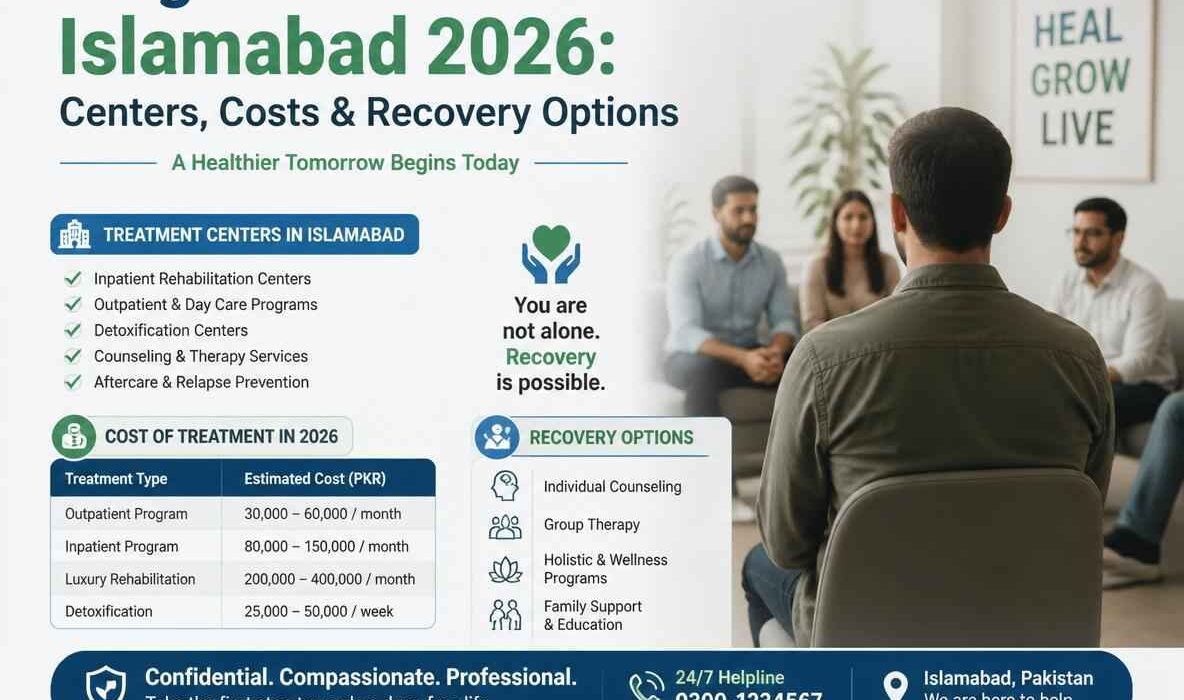
Cost in Islamabad: 80,000 to 250,000 PKR monthly (depending on facility tier). Private facilities like Healing Door in Bani Gala position themselves at the premium end of this range, typically 200,000-250,000 PKR/month. Mid-tier options run 120,000-160,000 PKR. Government-affiliated programs (attached to major hospitals) cost 30,000-50,000 PKR but have long waitlists and limited capacity.
What to verify: Confirm whether the cost includes medication, counseling, meals, and transportation. Some facilities charge separately for psychiatric medication or specialized therapies (like equine therapy). Ask how many counselors are available—the best ratio is one counselor per 6-8 residents. Verify whether the facility has a psychiatrist on-site daily or only on call.
Red flags: Centers claiming “guaranteed cure,” those with no family involvement policy, facilities without a documented aftercare plan, or programs where everyone follows the same schedule regardless of substance type.
Outpatient Intensive Program (IOP) — 3 to 5 Days Weekly
The person lives at home but attends the treatment center 3 to 5 days per week for 4 to 8 hours daily. Sessions include group and individual therapy, medical monitoring, and medications as needed. The person maintains employment, family structure, and community connections while receiving professional support.
Who benefits: People with mild to moderate addiction, stable home environments, jobs they want to keep, and family support. Also ideal for stepping down from inpatient programs (aftercare) or for those who cannot afford extended residential stays.
Cost in Islamabad: 40,000 to 80,000 PKR monthly. This is often overlooked because it sounds less “serious” than inpatient, but data shows IOP with strong family involvement and aftercare achieves outcomes comparable to inpatient for many user profiles.
What to verify: Does the schedule work with the person’s job or school? What happens if they miss a session? How are medications managed if the person isn’t living at the facility? Is there a backup psychiatrist if the primary one is unavailable?
Red flags: Programs with vague attendance policies, no coordinator tracking missed sessions, facilities that don’t integrate with local psychiatric services for ongoing medication management.
Medication-Assisted Treatment (MAT) Clinics
Daily or twice-weekly visits to take medications (buprenorphine, methadone, or naltrexone) under supervised conditions, plus weekly counseling. Structured to prevent diversion (selling the medication) while allowing the person to function in daily life.
Who benefits: People with opioid addiction who’ve failed multiple other approaches, those with jobs or family commitments, and individuals in recovery who need extended pharmaceutical support (months to years). Also used for alcohol dependence.
Cost in Islamabad: 8,000 to 15,000 PKR monthly (medication + clinic fees). Far less expensive than residential treatment but requires reliable transportation and commitment to weekly clinic visits indefinitely.
What to verify: Does the clinic have Narcotics Control Board (NCB) approval? Are medications sourced from verified pharmaceutical suppliers? What happens if the person misses a dose—can they re-dose the same day? Is there a psychiatrist reviewing medication levels?
Red flags: Clinics operating without formal regulatory approval, those selling medications privately without supervision, facilities where attendance is optional or unmonitored.
Drug Addiction Treatment in Bani Gala & Islamabad: Facility Comparison
Bani Gala, a high-income neighborhood in Islamabad, hosts several premium rehab centers. However, premium pricing does not guarantee better outcomes.
| Facility Type | Typical Cost (Monthly) | Best For | Key Consideration |
|---|---|---|---|
| Premium Residential (Bani Gala tier) | 200,000–300,000 PKR | Severe addiction with family funds, desire for privacy/discretion, co-occurring mental health | Verify credentials; premium amenities ≠ better therapy |
| Mid-tier Residential | 100,000–160,000 PKR | Moderate-to-severe addiction, limited budget, structured environment needed | Compare therapist qualifications; ensure aftercare included |
| Government Hospital Affiliated | 20,000–50,000 PKR | Limited finances, severe medical complications, need for psychiatric integration | Long wait times; smaller staff; basic amenities |
| Intensive Outpatient (IOP) | 40,000–80,000 PKR | Moderate addiction, employment/family stability, aftercare from inpatient | Requires stable home; self-motivated participation |
| Medication-Assisted (MAT) | 8,000–15,000 PKR | Opioid-dependent individuals, long-term maintenance, cost-sensitive | Ongoing indefinite medication; no “cure” endpoint |
The Bani Gala premium question: Does paying 250,000 PKR/month produce better outcomes than a 120,000 PKR program? Evidence suggests the answer is: it depends. The differentiator is therapist expertise and aftercare quality, not marble floors or private rooms. Some premium centers excel here. Others spend more on facilities than on hiring specialized addiction psychiatrists. Before assuming expensive equals better, ask specifically:
- How many certified addiction counselors (not general counselors) are on staff?
- What are the therapists’ credentials and specific addiction medicine training?
- What percentage of clients remain abstinent 12 months after discharge?
- Do they have partnerships with employers or community resources for job re-entry?
What to Expect: The Realistic Timeline and Stages of Recovery
Most people underestimate the length of recovery. They expect a 30-day program to “fix” the addiction. That’s not how addiction works.
Detoxification (Days 1–7, typically): The body withdraws from the substance. This is acutely uncomfortable—anxiety, insomnia, muscle pain, sweating—but medically manageable with proper support. Medical protocols use short-term medications (anti-anxiety, sleep aids) to ease symptoms. This phase is not where “cure” happens; it’s where stabilization begins.
Early Recovery (Weeks 2–8): Psychological dependence emerges as the acute physical symptoms fade. The person realizes they miss the substance, that they used it to manage emotions, and that they don’t yet have alternative coping tools. Cravings peak around week 3-4. This is the phase where most people relapse if not in structured treatment. Daily programming, group support, and family involvement are critical here.
Stabilization (Months 2–4): New routines replace old drug-use rituals. The person reintegrates with family, maybe returns to work. Therapies shift from crisis management to addressing underlying triggers: trauma, depression, relationship problems, financial stress. This phase requires consistent outpatient follow-up. Many drop out here because they “feel better” and assume they don’t need ongoing support. Relapse rates spike if treatment stops.
Maintenance (Months 4 onward): The person is functioning, but still rebuilding relationships, employment, and identity without substances. This phase lasts 1 to 2 years, sometimes indefinitely. Support comes from outpatient counseling, 12-step groups or alternatives, family involvement, and sometimes ongoing medication.
A facility promising results faster than this timeline is not being truthful.
Healing Door and Other Premium Rehab Centers in Islamabad: What to Actually Evaluate
Healing Door Rehab Center is among the most visible premium options in Bani Gala. It markets privacy, medical expertise, and international-standard facilities. This doesn’t mean it’s automatically the right choice.
Transparent evaluation points:
- Licensing and regulatory status: Is it registered with the Pakistan Medical Commission? Does it have valid NOCs (No Objection Certificate) from local health authorities? Verify this independently; don’t just accept their claim.
- Clinical team credentials: Ask for the CV of the psychiatrist, lead counselors, and medical director. How many years of addiction-specific experience? Are they members of professional bodies (Pakistan Psychiatric Association, etc.)? Premium facilities sometimes staff generalist psychiatrists, not addiction specialists.
- Assessment process: Do they assess the person before intake, or do they accept everyone into the same program? Proper facilities conduct medical and psychological evaluations, then match the person to a specific program track (opioid focus vs. behavioral addiction vs. co-occurring mental health, etc.).
- Aftercare clarity: What happens after discharge? Do they provide outpatient follow-up, or do you have to find a new provider? Can they coordinate with a local psychiatrist for medication management? Do they offer family follow-up sessions?
- Transparency on outcomes: Ask directly: “What percentage of your clients are abstinent 6 months after discharge?” Legitimate centers will have this data. If they don’t track it, that’s a significant warning sign.
- Insurance and payment: Do they work with insurance companies, or cash-only? If cash-only, are payment plans available? What’s included in the quoted price?
- Unexpected costs: Some premium centers quote a base fee, then charge separately for psychiatric medication, family sessions, or extended aftercare. Clarify this before committing.
The “premium” label is marketing. The actual value is in clinical depth, personalized treatment planning, and what happens after discharge. A center charging 120,000 PKR with a strong aftercare track record may deliver better outcomes than a 250,000 PKR facility with weak discharge planning.
Questions to Ask Any Treatment Center Before Enrolling
Use this checklist. If a facility hesitates to answer these directly, find another option.
Clinical Questions:
- What is your medical director’s specific training in addiction medicine?
- How do you assess what type of treatment each person needs? (They should interview you, not assume one-size-fits-all)
- What medications do you use for detoxification, and which psychiatrist prescribes them?
- Can you treat co-occurring mental health conditions (depression, anxiety, PTSD)? If yes, is a psychiatrist or only a counselor involved?
Operational Questions:
- What is your staff-to-client ratio for counselors and medical staff?
- What happens if someone has a psychiatric emergency during treatment?
- How do you handle clients who want to leave before the program ends? (Legitimate centers don’t lock people up, but they should have protocols.)
- Are family members allowed to visit, call, or attend sessions? How frequently?
Outcomes and Discharge:
- What percentage of your clients complete the program? (If less than 60%, consider why—poor treatment or wrong selection?)
- What happens after discharge? Do you provide outpatient follow-up?
- Can you connect me with a local psychiatrist for ongoing medication management?
- Do you offer family follow-up sessions after the person is home?
Costs:
- What is included in your quoted monthly fee? (Medications? All therapy sessions? Meals? Transportation?)
- What costs extra?
- What happens if we need to extend beyond the initial timeframe?
Red Flags That Indicate an Untrustworthy Facility
- Guarantees of cure or specific success rates — addiction doesn’t work that way; legitimate centers offer ranges and emphasize ongoing commitment.
- No medical supervision or psychiatrist on-site — this is critical for safe detoxification and managing co-occurring mental health.
- Family involvement discouraged or restricted — family therapy is evidence-based; if they limit it, they’re limiting outcomes.
- All clients follow identical schedules and programs — real treatment is individualized; opioid addiction and methamphetamine addiction need different approaches.
- No aftercare plan, or aftercare costs extra — aftercare is where relapse prevention happens; it shouldn’t be an upsell.
- Reluctance to discuss outcomes or staff credentials — transparent centers have answers; evasiveness is a warning sign.
- Operating without formal regulatory approval — verify with local health authorities.
- Pressure to pay upfront for long durations — legitimate centers often work on monthly or payment-plan terms.
- Spiritual focus without clinical backbone — faith can support recovery, but it’s not a substitute for therapy and medical management.
- Claims of “natural” or “non-medication” cures — opioid addiction especially requires medication for safe management; avoiding medication is dangerous.
Navigating Cost and Insurance in Pakistan
Drug addiction treatment in Islamabad remains largely out-of-pocket. Few insurance policies in Pakistan cover residential rehab, though this is changing.
Realistic cost scenarios:
- Severe addiction, inpatient 60 days: 240,000–360,000 PKR total (assuming 4,000–6,000 PKR daily)
- Moderate addiction, IOP 12 weeks: 120,000–240,000 PKR total (40,000–80,000 PKR monthly × 3 months, sometimes less)
- Opioid maintenance (MAT) 12 months: 96,000–180,000 PKR (8,000–15,000 PKR monthly, ongoing)
- Government hospital program (subsidized): 20,000–50,000 PKR monthly, but limited availability and waitlists of 3-6 months
Payment strategies:
- Some families pool resources across relatives.
- Some facilities offer payment plans over 3-6 months rather than requiring full upfront payment.
- Government programs (attached to large hospitals like PIMS, Shifa International in Islamabad) are cheaper but have longer waitlists and fewer specialized addiction resources than private centers.
- Some employers offer employee assistance programs (EAPs) that cover a portion of treatment; check your or your relative’s workplace policy.
When to negotiate: If a facility quotes 250,000 PKR and your budget is 150,000 PKR, ask whether a shorter stay followed by structured outpatient care is available. Some centers are flexible if they understand your constraint is financial, not commitment-based.
After Treatment: The Critical Aftercare and Relapse Prevention
This is where most treatment articles skip detail, and it’s exactly where failure happens.
Aftercare isn’t optional. It’s the structural difference between someone who stays sober and someone who relapses. Here’s what to put in place before your relative even leaves the treatment center:
During inpatient program: Ask the facility to draft a written aftercare plan specifying:
- Weekly outpatient counseling (schedule the first appointment before discharge)
- Psychiatric follow-up (medication management) every 4-6 weeks
- Whether they’ll attend 12-step groups (AA, NA) or alternatives like SMART Recovery
- Family counseling frequency (at least monthly for the first 3 months)
- A contact person if cravings spike or relapse urges emerge (24/7 hotline or counselor)
After returning home: The person is vulnerable. Their brain still has rewired pathways leading to the substance. Their social circle likely still includes people who use. They may face judgment or shame. Your role as a family member shifts to:
- Attending family counseling sessions (this is not punishment; it’s repair and relapse prevention)
- Helping rebuild structure at home—consistent wake times, meals, exercise, sleep
- Avoiding criticism or dwelling on past use (shame fuels relapse)
- Noticing early relapse warning signs: social withdrawal, mood changes, dishonesty, missing appointments
- Having a plan: if relapse urges emerge, they call their counselor or go to an emergency room rather than using
Community resources in Islamabad:
- Narcotics Anonymous (NA) meetings (weekly meetings at multiple locations in Islamabad; ask the treatment center for a current schedule)
- Pakistan’s Substance Abuse Prevention Program (SAPP) offers some free counseling resources
- Private psychiatrists for ongoing medication management (if the treatment center doesn’t provide it)
The best treatment center in Islamabad can’t guarantee success if there’s no structured follow-up. It’s that important.
CONCLUSION
Choosing drug addiction treatment in Islamabad requires filtering through marketing language and focusing on what actually drives recovery: medical competence, individualized assessment, family involvement, realistic timeline expectations, and structured aftercare. The most expensive facility in Bani Gala isn’t automatically the best; the right choice matches your specific situation—substance type, severity of addiction, financial constraints, family stability—to a center with proven clinical depth and transparent outcomes.
Start by getting a medical evaluation. Call the psychiatry departments at PIMS or Shifa International in Islamabad, or contact Healing Door if private treatment is feasible, and request an assessment. Ask the questions outlined in this article. Verify credentials and regulatory status. Get clarity on what happens after the initial program ends. Then decide based on clinical fit, not marketing, and commit to the full recovery timeline—not just detoxification, but the 6-12 months of aftercare that actually prevent relapse. Addiction is treatable. The right center, matched to your situation, makes that recovery real.
[6] FAQ SECTION
Q1: What’s the difference between inpatient rehab and outpatient treatment for drug addiction in Islamabad? Inpatient means living at the facility 24/7 with structured programming 8+ hours daily; best for severe addiction or unstable home situations. Outpatient (IOP) means living at home, attending 3-5 days weekly; better for employed individuals or moderate addiction. Outcomes can be comparable if both include strong aftercare; the choice depends on severity and home stability, not just preference.
Q2: How much does drug addiction treatment actually cost in Islamabad? Residential ranges from 50,000 PKR (government hospitals) to 250,000+ PKR monthly (premium private). Intensive outpatient costs 40,000-80,000 PKR monthly. Medication-assisted treatment (MAT) runs 8,000-15,000 PKR monthly. Total cost depends on duration (30-90 days inpatient, or 3-12 months outpatient). Ask what’s included before committing; some facilities charge separately for psychiatry or family sessions.
Q3: Is Healing Door Rehab Center in Bani Gala the best option in Islamabad? Premium pricing doesn’t guarantee better outcomes. Healing Door offers privacy and medical facilities, but so do mid-tier centers at lower cost. Compare outcomes (not amenities): staff credentials, clinical approach, aftercare quality, and documented success rates. A 120,000 PKR facility with strong aftercare may outperform a 250,000 PKR one with weak discharge planning.
Q4: Do insurance companies in Pakistan cover drug addiction treatment? Few standard insurance policies cover residential rehab in Pakistan as of 2026. Some employer EAPs offer partial coverage. Government hospital programs are cheaper (20,000-50,000 PKR monthly) but have long waitlists. Always verify current coverage with your insurer; this is changing.
Q5: How long does it take to recover from drug addiction? Detoxification takes 1-2 weeks. Early recovery (stabilization) takes 2-4 months. Full recovery timeline is typically 6-12 months of structured outpatient follow-up. Anyone promising a “cure” in 30 days is misleading you. The work after inpatient discharge is where relapse prevention actually happens.