Rehabilitation Center in Bani Gala: What to Check First
Somebody in your family has hit a point where things can’t continue the way they have been. Maybe it’s a spouse who’s been using for years and finally admitted it out loud. Maybe it’s a son who came home high one too many times. Whatever brought you here, you’ve probably already noticed that Bani Gala has quietly become the address most people in Islamabad associate with rehab — and that every clinic there describes itself as the calmest, most confidential, most “trusted” option in the city. A rehabilitation center in Bani Gala is not defined by its hillside views or its brochure language; it’s defined by what happens clinically inside the building, day to day, for the weeks or months a patient stays. This guide walks through exactly what separates a genuinely capable facility from one that’s simply well-marketed, including the accreditation claims worth checking and the ones you can skip past.
Why So Many Rehab Centers Cluster in Bani Gala
Bani Gala sits on the edge of Islamabad, bordered by the Margalla Hills and Rawal Lake, which gives it a quieter, more residential feel than the city center. That physical separation is genuinely useful for early recovery — fewer familiar dealers, fewer old drinking spots, less foot traffic past a patient’s window. It’s also become something of a self-reinforcing cluster: once a few facilities opened here and built reputations, families started searching “rehab Bani Gala” by default, and more centers followed.
That doesn’t make location the deciding factor, though. A quiet neighborhood reduces environmental triggers during the first stretch of treatment, but it doesn’t treat withdrawal, doesn’t manage a co-occurring psychiatric condition, and doesn’t build the coping skills a patient needs once they’re back in a triggering environment six months later. Location earns its place in your decision after clinical quality, not before it.
The Location Trade-Off Nobody Mentions
Distance cuts both ways. If your family is in Rawalpindi, Peshawar, or further out, Bani Gala’s hillside setting means longer, harder visits — and family involvement is one of the stronger predictors of a patient staying in treatment. Before you lock in a facility purely because it’s “in Bani Gala,” check its actual visiting policy and how it handles family sessions for relatives who can’t come weekly.
What a Legitimate Treatment Program Actually Includes
A real program is built around medical stabilization, structured therapy, and a documented aftercare plan — not just a residential stay. If any of these three pieces is missing or vague, that’s worth asking about directly.
Medical detox first. Withdrawal from alcohol, benzodiazepines, or opioids can be medically dangerous, not just uncomfortable. A facility should have a physician or addiction-medicine specialist overseeing detox, not just nursing staff checking in periodically.
Structured therapy, not just “counseling.” Cognitive Behavioral Therapy (CBT) and Motivational Interviewing are the two approaches with the strongest track record for substance use disorders. Group therapy adds peer accountability; individual sessions handle what a patient won’t say in a group.
Dual-diagnosis capability. In our review of treatment-seeking populations across Pakistani rehab centers, co-occurring depression, anxiety, or trauma shows up often enough that a facility unequipped to treat mental health alongside addiction is treating half the problem. Ask directly whether psychiatric evaluation is part of intake or an optional add-on.
What Happens After Discharge Matters More Than the Stay Itself
Most marketing pages focus entirely on the residential experience — the rooms, the grounds, the “healing environment.” Almost none go into real depth on aftercare, which is the phase where most relapse actually happens. A facility worth choosing should be able to describe, specifically, what happens in the first 90 days after a patient leaves: outpatient check-ins, relapse-prevention counseling, family support sessions, or a structured step-down program. If a center can’t answer that clearly in a first phone call, that’s a gap worth taking seriously.
Accreditation Claims: What They Mean and How to Check Them
Most Bani Gala facilities list some combination of accreditation logos — UNODC, Anti-Narcotics Force (ANF) recognition, or local healthcare regulatory approval. These aren’t interchangeable, and treating them as one generic trust badge misses what each actually confirms.
| Accrediting Body | What It Actually Signals |
|---|---|
| UNODC (United Nations Office on Drugs and Crime) | Alignment with UN drug-demand-reduction standards; UNODC has run a Pakistan country office for decades supporting government and civil-society programs, but recognition levels vary — ask the facility what specific UNODC engagement they’ve had, not just whether a logo is displayed |
| ANF (Anti-Narcotics Force Pakistan) | A federal law-enforcement body focused on narcotics control; being “recognized by” ANF is different from being licensed or inspected by them — ask what the recognition specifically covers |
| Islamabad Healthcare Regulatory Authority | The actual healthcare licensing body for facilities operating in the capital — this is the one worth confirming directly, since it governs whether a facility is legally permitted to operate as a healthcare provider |
None of this means a facility displaying these logos is misrepresenting itself. It means a badge on a homepage isn’t proof by itself. A two-minute phone call asking “what does your Islamabad Healthcare Regulatory Authority registration cover, and can I see it” separates facilities that welcome scrutiny from ones that get vague fast.
Inpatient vs. Outpatient: Which One Actually Fits
This decision changes based on severity, not preference. Someone using heroin daily for three years and someone drinking heavily on weekends are not candidates for the same program, even if both technically qualify as “addiction.”
| Factor | Inpatient (Residential) | Outpatient |
|---|---|---|
| Best for | Daily/severe substance use, prior failed attempts, unsafe home environment | Early-stage use, strong home support, employment/school that can’t pause |
| Typical duration | 30–120 days depending on severity and facility | Weeks to several months, ongoing sessions |
| Medical supervision | 24/7 on-site | Scheduled visits only |
| Cost pattern | Higher upfront, includes housing and full-time care | Lower per-visit cost, spread over time |
| Family involvement | Structured visiting hours and family therapy sessions | Easier day-to-day involvement since patient stays home |
| Relapse risk during treatment | Lower — controlled environment | Higher — patient still exposed to triggers daily |
If you’re uncertain which category fits, a proper intake assessment — not a sales call — should make that determination based on substance history, prior treatment attempts, and home environment. Be cautious of any facility that recommends its most expensive program before completing a real clinical assessment.
Family Involvement and Women-Specific Programs
Two things almost every Bani Gala facility markets but few explain in depth: how family is actually incorporated, and whether women’s programs are genuinely separate or just a marketing line.
Family’s role goes beyond visiting hours. For clients in Pakistan specifically, family dynamics are often part of both the problem and the solution — enabling behavior, financial pressure, or unspoken expectations can undermine recovery if nobody addresses them directly. A program that includes structured family counseling sessions, not just occasional visits, gives relatives the tools to support recovery without accidentally sabotaging it.
Women-only programs need to be structurally separate, not just labeled that way. A genuine women’s program means separate living quarters, a female-only clinical and support team where culturally appropriate, and privacy protections suited to how stigma around addiction affects women differently in Pakistani society. Ask specifically whether “female rehabilitation services” means a fully separate track or simply a female counselor assigned within a mixed facility.
What Drives the Cost of Treatment
No reputable facility should give you a number over the phone without an assessment — costs depend on program length, level of medical supervision, and whether detox is included. What you can control is understanding what factors into that number before you’re presented with a package:
- Program length — a 30-day stay and a 120-day stay are not proportionally priced the same way; longer stays often carry better per-day value
- Level of medical supervision required — a patient needing monitored opioid or alcohol detox costs more to treat safely than someone in early-stage cannabis use
- Room type — shared vs. private accommodation, which several Bani Gala facilities offer at different tiers
- Aftercare inclusion — some programs bundle 90 days of outpatient follow-up into the initial cost; others charge separately
- Family therapy sessions — included in some packages, billed as add-ons in others
Pricing and package structures change; always confirm current rates and what’s included directly with the facility rather than relying on older blog posts or third-party listing sites.
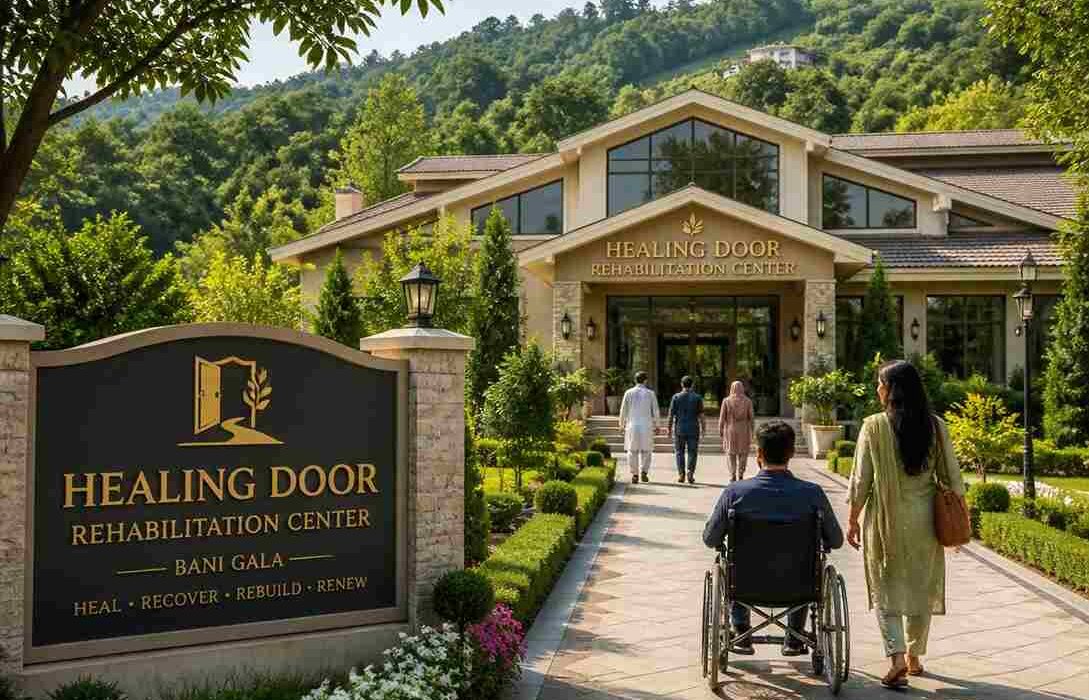
Healing Door Rehab Center (HDRC): A Bani Gala Option Worth Knowing
Healing Door Rehab Center operates from Bani Gala, opposite Meezan Bank on Main Jinnah Road, and has been running for more than 10 years. It’s worth including here not as a sales pitch, but because it illustrates several of the points above in practice.
HDRC’s clinical team includes Dr. Asad Ali Noor (Consultant Psychologist and Addiction Therapist, CEO), Dr. Nasir Mehmood Abbasi (Medical and Addiction Specialist), Prof. Dr. Jan Alam (Consultant Psychiatrist and Psychotherapist), Dr. Shahid Ikram (physician and addiction-treatment specialist), and several clinical psychologists including Ms. Aneela Sarfraz and Ms. Ammarah Shaarif. That range matters directly to the dual-diagnosis question raised earlier — psychiatric and addiction-medicine expertise sitting under one roof rather than referred out.
On accreditation specifically: HDRC states recognition from the Anti-Narcotics Force Pakistan and approval status with UNODC and IHRA Pakistan, alongside listing under the Islamabad Healthcare Regulatory Authority. Following this article’s own advice, prospective patients should still confirm current registration status directly with the facility rather than taking any homepage claim at face value — that applies here exactly as it applies to every competitor mentioned above.
Service-wise, HDRC covers drug addiction treatment, medically supervised detox, alcohol abuse treatment, psychiatric services, a dedicated ICE (crystal meth) rehabilitation track, a separate female rehabilitation program, an in-house medical clinic, and general mental health and psychiatric care — both inpatient and outpatient. That range means dual-diagnosis patients, who are common rather than exceptional, don’t need to be referred elsewhere mid-treatment.
Choosing the Right Facility: A Practical Checklist
Before committing to any rehabilitation center in Bani Gala, work through this list on a call — not just the website:
- Confirm current Islamabad Healthcare Regulatory Authority registration and ask to see it
- Ask who performs the intake assessment and whether it happens before or after payment discussion
- Confirm on-site medical detox capability, not just “detox support”
- Ask specifically how dual diagnosis (addiction plus a mental health condition) is handled
- Get the aftercare plan in writing — what happens in the first 90 days post-discharge
- If relevant, confirm whether the women’s program is structurally separate
- Ask how family sessions are structured, not just when visiting hours are
- Get current pricing directly, understanding it depends on assessment outcome
If a facility hesitates on more than one or two of these, treat that as useful information rather than a dealbreaker in itself — but keep asking.
The Decision That Actually Matters
Bani Gala’s setting is a genuine asset for recovery, but it’s not the reason to choose one facility over another. The reason is what happens clinically once the intake paperwork is signed: whether detox is medically supervised, whether dual diagnosis gets treated rather than ignored, whether family is actually built into the process, and whether there’s a real plan for the months after discharge. Verify accreditation directly rather than trusting a logo, ask for the aftercare plan in writing, and choose based on the assessment a facility gives you — not the one it tries to sell you first. That’s the difference between a good outcome and an expensive false start.
FAQ SECTION
1. What makes Bani Gala a common location for rehab centers in Islamabad? Bani Gala’s distance from the city center and its setting near the Margalla Hills reduce everyday exposure to triggers like familiar dealers or drinking spots. Several established facilities are based there, which has made it the default search location for families in Islamabad looking for treatment.
2. Is a rehabilitation center in Bani Gala better than one in central Islamabad? Not automatically. Location affects environmental triggers and travel logistics for family visits, but clinical quality — medical staff, detox capability, and aftercare planning — matters more to outcomes than neighborhood setting alone.
3. How do I verify a rehab center’s accreditation claims? Ask directly what a specific accreditation covers and request to see current registration, particularly with the Islamabad Healthcare Regulatory Authority, which is the actual licensing body for healthcare facilities in the capital. A homepage logo isn’t proof by itself.
4. What’s the difference between inpatient and outpatient rehab? Inpatient means 24/7 residential care with full medical supervision, typically used for severe or daily substance use. Outpatient allows the patient to live at home while attending scheduled sessions, better suited to earlier-stage use with strong home support.
5. How long does rehab treatment typically take? Programs commonly run 30 to 120 days depending on the substance, severity, and whether medical detox is required. Longer stays are generally associated with lower relapse rates, though the right length depends on individual assessment.
6. Do rehab centers in Bani Gala treat mental health conditions alongside addiction? Facilities equipped for dual diagnosis do, treating co-occurring depression, anxiety, PTSD, or other conditions alongside substance use. It’s worth asking directly whether psychiatric evaluation is part of intake, since not every facility offers this depth.
7. Are there women-only rehab programs in Bani Gala? Some facilities, including Healing Door Rehab Center, offer dedicated female rehabilitation programs. Confirm whether this means fully separate living quarters and staff, or simply a female counselor within a mixed-gender facility.
8. How much does rehab cost in Islamabad? Cost depends on program length, level of medical supervision, room type, and whether aftercare is included in the package. Reputable facilities won’t quote a firm number without a clinical assessment first, and current pricing should always be confirmed directly with the center.
9. What should family members expect during a loved one’s treatment? Most programs include structured visiting hours and family therapy sessions rather than open-ended visits. Family involvement is strongly linked to a patient staying in treatment, so ask how sessions are structured before enrollment, not after.
10. What happens after a patient completes treatment? A solid program includes a documented aftercare plan covering the first 90 days post-discharge — outpatient check-ins, relapse-prevention counseling, and often continued family support. This phase is where most relapse risk concentrates, so it deserves as much scrutiny as the residential program itself.