What Is Recovery Treatment? The 7 Stages, Explained for Families
By Dr Asad Ali Noor, CEO & Consultant Psychologist · Medically reviewed by Prof Dr Jan Alam, Consultant Psychiatrist & Psychotherapist · Last reviewed: 14 November 2026
The short answer
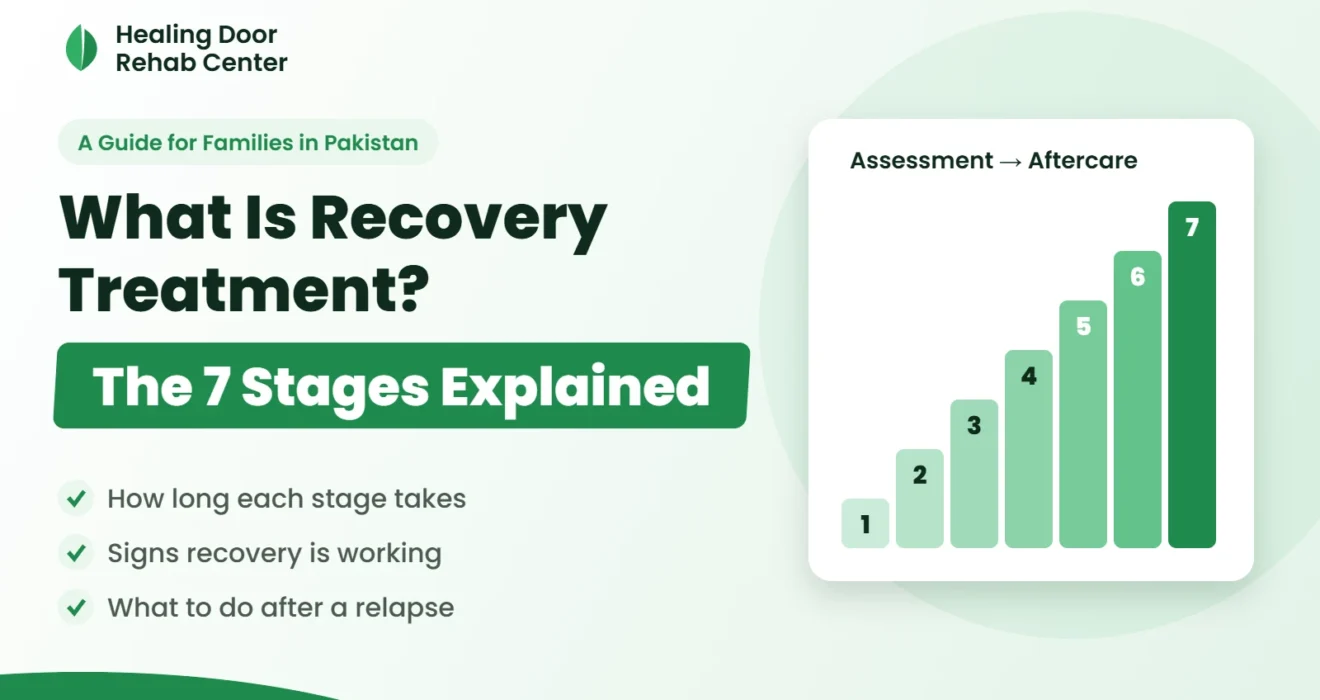
Recovery treatment is the full course of care that takes a person from active addiction to a stable life without the drug. It has seven stages: assessment, medically supervised detox, stabilisation, structured therapy, treatment of any mental illness alongside the addiction, relapse prevention, and aftercare. Detox takes days; therapy takes weeks to months; aftercare continues for at least a year. Recovery is working when sleep, honesty and daily routine improve and the person reaches for help, not the drug, on a bad day.
Key takeaways
- Recovery is more than “not using”. It means health, relationships, work and trust coming back.
- No stage can be skipped. Most failed attempts in Pakistan stop after detox.
- In Pakistani households, the family’s role is part of the treatment, not a side issue.
- A relapse is a signal to adjust the plan, not proof that treatment failed.
Not sure which stage your family member needs first? Tell us what they use and what has happened so far. We will tell you honestly where to start, even if it is not with us. 📞 Call: +92 314 992 2547 · 💬 WhatsApp: Ask which stage to start with · Open 24/7 · Free, confidential assessment
At a glance
| Stage | What happens | Typical length |
|---|---|---|
| 1. Assessment | Doctor, psychiatrist and psychologist build the plan | 1–2 days |
| 2. Detox | Withdrawal managed safely | 3–10 days (weeks for tablet tapers) |
| 3. Stabilisation | Sleep, appetite and mood settle | 1–3 weeks |
| 4. Structured therapy | CBT, group and family work change the pattern | 4–12 weeks or more |
| 5. Dual diagnosis care | Depression, anxiety, trauma or psychosis treated alongside | Runs in parallel |
| 6. Relapse prevention | A written plan for the person’s own triggers | Built during therapy |
| 7. Aftercare | Follow-up, therapy and family support at home | 12 months or longer |
What recovery treatment is, and what it is not
The US agency SAMHSA defines recovery as a process of change through which people improve their health and wellness, live a self-directed life and strive to reach their full potential. Recovery treatment is how that process is delivered: organised medical and psychological care, in stages, over time.
Three words are often mixed up:
- Sobriety means not using right now.
- Remission means the signs of the disorder have reduced or stopped for a period.
- Recovery is wider: sleep, thinking, relationships, work and trust rebuilt around a life without the drug.
A man can be “clean” for two weeks in a locked room and still have changed nothing. That is why good treatment aims for recovery, not just abstinence. It is also not a one-time event, not willpower alone, and not one therapy that suits everybody. The National Institute on Drug Abuse describes addiction as a treatable, chronic disorder of the brain and behaviour. Read what addiction is if you are new to the subject.
Why recovery looks different in Pakistan
Most international guides assume a patient who chooses treatment, insurance that pays for it, and a dense network of meetings and sober-living homes. Families in Pakistan usually face a different picture:
- The family finds the centre, pays, and receives the patient home. So the family’s habits (money, phone contacts, arguments, taunts) shape recovery as much as any therapy.
- Stigma delays treatment. Many families wait until the problem is years old, out of fear of what relatives or the mohalla will say. Late treatment is harder treatment.
- Specialists are scarce. A 2026 Ministry of National Health Services report counted about 470 active psychiatrists for a population of over 255 million (Minute Mirror, 30 Oct 2026). Choose a centre where a named psychiatrist actually sees the patient.
- Aftercare support is thin. Narcotics Anonymous meetings exist in larger cities but are few, and sober-living houses are rare. Aftercare has to be planned deliberately, often through outpatient visits, video sessions and the family.
- Forced “pick-ups” are not treatment. Under the Mental Health Ordinance 2001, addiction alone is not grounds for involuntary admission (Dawn, 14 Aug 2021). Real recovery starts with engagement, even if that engagement begins reluctantly.
The 7 stages of recovery treatment
Stage 1: Assessment
A doctor and psychiatrist take a full history: every substance, amount, years of use, past attempts to stop, physical health, withdrawal risk, and mental state. A clinical psychologist looks at the family, work, routine and the situations in which use happens. The result is a written, individual plan: setting, medical risks, first therapies, any medicine, and goals the family can recognise.
Ask: “Who will assess him, and when do we see the plan?”
Stage 2: Medically supervised detox
Use stops and withdrawal is monitored and treated. Alcohol and sedative withdrawal can be dangerous; heroin withdrawal is intensely distressing and often ends in relapse without support; ice withdrawal brings a crash in mood and sleep. Detox makes the body safe; it does not change behaviour. Our guide to what a detox program involves explains day 1 to day 30.
Stage 3: Stabilisation
Once acute withdrawal passes, sleep, appetite and mood are still unsettled and cravings start attaching to particular people, times and places. A predictable daily rhythm (waking, meals, prayer if the person wishes, exercise, therapy and rest) gives the recovering brain structure. Problems hidden by drug use often surface here, such as anxiety that alcohol was numbing or depression that ice was masking.
Stage 4: Structured therapy
This is the stage that changes the future. Therapy traces the chain that leads this particular person to use (trigger, thought, feeling, craving, decision) and rehearses a different response at each link. The main methods:
- Cognitive behavioural therapy (CBT): spotting high-risk situations, challenging thoughts like “one time won’t matter”, practising refusal.
- Motivational interviewing: helping a person who is half-willing find their own reasons to change, without lectures.
- Family therapy: boundaries, communication, money, and the line between supporting someone and shielding them from consequences.
- Group therapy: hearing your own story in someone else’s reduces shame and isolation.
- Contingency management: agreed rewards for clear progress such as negative drug tests; it has the strongest evidence for ice and other stimulants.
Stage 5: Dual diagnosis care
Depression, anxiety, trauma, bipolar disorder and psychosis often travel with addiction. Either can come first: some people use to sleep or blunt memories, and long use worsens mood and anxiety. Both conditions need one team and one plan. Treating only the addiction leaves a door open back to the drug. See dual diagnosis treatment.
Stage 6: Relapse prevention
Patient and therapist map the person’s own route back to use: which friends, which streets, payday, arguments, boredom, loneliness, physical pain. From that map comes a written plan with “if this, then that” steps: who to call, where to go, how to handle cash and old phone numbers, and what to do in the first hour of a strong craving.
Stage 7: Aftercare
Aftercare is agreed before discharge, with names and dates: follow-up appointments, ongoing therapy, psychiatric review if medicine continues, and family guidance. Some people attend Narcotics Anonymous or Alcoholics Anonymous meetings; others find support through their mosque, a mentor or a structured routine of work and exercise. Overseas Pakistanis who return abroad can continue sessions by video. See relapse prevention and aftercare.
Planning for the return home? We build the family plan before discharge: money, phone contacts, warning signs and who to call. 📞 +92 314 992 2547 · 💬 Ask about aftercare
How the person changes inside treatment
Clinical stages describe what the team does. The “stages of change” describe where the patient is:
| Stage of change | What it looks like at home | What helps |
|---|---|---|
| Not ready | “I can stop whenever I want.” | Calm facts, no lectures, keep the door open |
| Thinking about it | Admits some harm, still defends the drug | Motivational conversations, an assessment |
| Preparing | Agrees to see a doctor, asks about leave from work | Fast practical help before the window closes |
| Acting | In treatment, practising new responses | Consistent family support, no rescuing |
| Maintaining | Protecting the change in daily life | Aftercare, routine, early action on warning signs |
People move back and forth. A patient who was committed on Monday can be doubtful again after one family argument on Tuesday. Clinicians read that as information, not dishonesty.
Where medicine fits
For some addictions, medicine reduces withdrawal or craving. NIDA lists:
- Opioids: methadone, buprenorphine and naltrexone. In Pakistan, long-term opioid substitution is available only in a few specialist programmes, so ask any centre plainly what it can provide.
- Alcohol: naltrexone, acamprosate and disulfiram.
- Nicotine: nicotine replacement, bupropion and varenicline.
There is no approved medicine for ice, cocaine or charas dependence, so therapy carries more of the load. Prescribing is always a doctor’s decision for one patient. Medicine supports therapy; it never replaces it.
How long does recovery treatment take?
There is no honest single number. NIDA notes that most people need at least three months of treatment to significantly reduce or stop use, and that longer treatment generally gives better results. As a rough shape:
- Early phase (days to weeks): assessment, detox, stabilisation.
- Middle phase (weeks to months): therapy, dual diagnosis care, relapse prevention.
- Ongoing phase (a year or more): aftercare, stepping support up or down with risk.
What changes the timeline: the substance and how long it was used; physical health (liver, hepatitis, nutrition); mental illness; how many times treatment has been tried before; whether drugs or users are still around at home; and whether the person stays engaged. The most common mistake families make is bringing someone home the moment the crisis calms down, before therapy has had time to work.
What to do if relapse happens
Relapse usually builds before it happens:
- Emotional build-up: poor sleep, bottled-up anger, skipping sessions, isolation.
- Mental build-up: remembering only the good times, “just once”, drifting near old friends.
- Use.
The earlier it is interrupted, the easier. NIDA puts relapse rates for addiction at 40 to 60 percent, similar to other chronic illnesses such as high blood pressure and asthma. Relapse means the plan needs changing, not that the person is hopeless.
What families should do: stay calm, avoid shaming, contact the treating team the same day, remove cash and access where possible, and assess safety. Overdose warning: after weeks without opioids, tolerance drops. An old dose of heroin can now be fatal. If someone is very drowsy or breathing slowly after using, call 1122.
Signs recovery is working
- Sleep settles and appetite returns.
- Cravings still come, but the person names them and uses the plan.
- Small promises get kept: attending sessions, coming home on time, handing over money.
- Honesty arrives earlier. “I had a bad day and wanted to use” is progress, not failure.
- Conflict at home is handled without disappearing or using.
Residential or outpatient: how the setting is chosen
Residential care fits when withdrawal needs medical watching, use is heavy or mixed, a mental illness needs close observation, drugs are available at home, outpatient attempts have failed, or the person needs distance from suppliers. Outpatient care fits milder cases with a safe, supportive home and stable health, or as a step down after residential care. A good centre explains its recommendation for your family member specifically. See inpatient rehab in Islamabad.
How to check a centre before admission
Ask each centre to show its registration with the relevant regulator (in Islamabad, the Islamabad Healthcare Regulatory Authority) and check the number yourself. Ask who leads the clinical team, whether every patient is assessed by a psychiatrist, what medical cover exists at night, which therapies are used, how families are involved, and what aftercare is written down before discharge. Our 12-point rehab checklist has the full list.
Recovery treatment at Healing Door
Healing Door Rehab & Psychiatric Center in Bani Gala, Islamabad, has delivered addiction and psychiatric care under one roof since 2014. Every admission begins with medical and psychiatric assessment; detox is led by Dr Shahid Ikram; psychiatric care by Dr M. Iqbal Khan and Prof Dr Jan Alam; and therapy by our clinical psychologists. Families take part through structured sessions, and aftercare (including video follow-up for overseas families) is written down before discharge. Meet the Healing Door Rehab team before you decide.
Talk to someone today You do not need to have every answer. One conversation will tell you what the first step should be. 📞 Call: +92 314 992 2547 · 💬 WhatsApp: Start a confidential chat · Open 24/7
Frequently asked questions
What is recovery treatment in simple words?
Organised medical and psychological help for addiction. It assesses the person, manages withdrawal safely, uses therapy to change the pattern of use, treats any mental illness alongside, prepares for relapse risks and supports the person after they go home.
What are the 7 stages of recovery?
Assessment, detox, stabilisation, structured therapy, dual diagnosis care, relapse prevention and aftercare.
Is detox enough on its own?
No. Detox clears the drug and manages withdrawal. Without therapy and aftercare, the triggers, habits and untreated illnesses that led to use stay in place.
How long does addiction recovery take?
Detox takes days, therapy takes weeks to months, and aftercare continues for a year or more. NIDA suggests at least three months of treatment for most people.
Can addiction be cured permanently?
It is better described as treatable and manageable, like diabetes or high blood pressure. Many people stay well for life, but ongoing care and early action on warning signs remain part of recovery.
Does relapse mean treatment failed?
No. It means the plan, its intensity or its support needs adjusting. Acting quickly matters more than blame.
Can someone be treated for addiction and depression together?
Yes, and they should be. Each condition can keep the other going, so one integrated plan works better than treating them separately.
Can we force an adult into recovery treatment?
Not for addiction alone under the Mental Health Ordinance 2001. Involuntary admission requires a mental disorder and a formal process with medical recommendations. Most patients agree after a calm, planned family conversation; a psychiatrist can guide it.
What is the family’s role in recovery?
Large. Families decide how money, phones and home rules work after discharge. Family therapy teaches how to support without rescuing, and how to respond to a lapse calmly.
This article is general information, not medical advice for a specific person. In an emergency, call 1122.