What Is a Detox Program? What Happens From Day 1 to Day 30
By Dr Asad Ali Noor, CEO & Consultant Psychologist · Medically reviewed by Dr Shahid Ikram, Attending Physician & Addiction Treatment Specialist · Last reviewed: 14 November 2026
The short answer
A detox program is medically supervised care for the days when a person stops alcohol or a drug their body has come to depend on. A doctor assesses the risk first, staff check pulse, blood pressure and symptom scores around the clock, and medicines are used where needed to prevent seizures, ease withdrawal and protect sleep. Most of the danger sits in the first 72 hours. Physical withdrawal usually settles within one to two weeks, but cravings, poor sleep and low mood can last longer, which is why detox is the first stage of treatment and not the whole of it.
Key takeaways
- Never stop alcohol, Xanax-type tablets or other sedatives suddenly at home after heavy daily use. Seizures can start within 6 to 48 hours.
- Detox treats the body. It does not treat the reasons someone uses, so therapy must follow without a gap.
- A good programme can tell you who is awake at night, which scores they use, and which doctor reviews them.
- After detox, tolerance is lower. Going back to an old dose of heroin or another opioid can kill.
Someone at home is in withdrawal right now? Tell us what they use, how much, and when they last used. A doctor-led team will tell you whether it is safe to wait. 📞 Call: +92 314 992 2547 · 💬 WhatsApp: Describe the withdrawal on WhatsApp · Open 24/7 · Free, confidential assessment
Emergency signs (fit, severe confusion, chest pain, collapse, slowed breathing): call 1122 first.
At a glance
| Question | Short answer |
|---|---|
| What is a detox program? | Supervised medical care through withdrawal, followed by a hand-over into therapy. |
| Is it the same as a detox cleanse or juice plan? | No. That is a wellness product. Medical detox is for physical dependence on alcohol or drugs. |
| Most dangerous withdrawals? | Alcohol and benzodiazepines (Xanax, Lexotanil, Rivotril type tablets): seizures and delirium are possible. |
| When is the risk highest? | Usually the first 24 to 72 hours; benzodiazepine withdrawal can start later. |
| How long does detox take? | Often 5 to 10 days for the acute phase; a benzodiazepine taper takes weeks. |
| Does detox cure addiction? | No. NIDA calls detox only the first stage of treatment. |
| Can it be done at home? | Sometimes, for milder cases, but only after a doctor has assessed the risk. |
Two meanings of “detox”, and which one this is
Type “detox program” into Google and you will see juice cleanses next to hospital guidance. The wellness kind promises to flush out everyday “toxins”. This guide is about the medical kind: what happens when a body that has adapted to alcohol, heroin, ice, tablets or charas has to work without them.
Regular use changes the brain and body. Sleep, heart rate, temperature, digestion and the brain’s calming and reward systems all reset around the substance. When it stops suddenly, those systems swing the other way. With some drugs that swing is mostly misery. With others it can cause a seizure, dangerous confusion or a racing heart. A detox program exists to manage that swing safely and then hand the person on to the treatment that actually changes their life.
Who needs supervised detox, and when is home detox unsafe?
Anyone who might be physically dependent should be assessed by a doctor before stopping. The warning signs families in Pakistan describe most often are:
- Using every day or almost every day, often from the morning.
- Needing more to get the same effect.
- Shaking, sweating, vomiting, panic or a “fit” during an earlier attempt to stop.
- Mixing substances, for example alcohol with sleeping tablets, or heroin with Xanax-type pills.
- Hiding tablets, or buying them without prescription from more than one medical store.
Home detox is unsafe when any of these apply: heavy daily drinking; daily benzodiazepine or other sedative use; a past withdrawal seizure or delirium; heart, liver, lung or kidney disease; pregnancy; older age; severe depression or suicidal thoughts; or a history of psychosis.
The problem with home detox is not love or effort. It is that nobody is measuring anything. There is no blood test for liver damage or low salts, no urine screen to show a second drug, no one scoring symptoms at 3 a.m. A relative may hand over leftover sleeping tablets without knowing the interaction risk, or miss the early confusion that comes before delirium tremens. And if the person gives up halfway and uses their old dose, they may be using it on a body that no longer tolerates it.
Not sure if home detox is safe? Send us the substance, the daily amount and the time of last use. We will tell you honestly whether supervised care is needed. 📞 +92 314 992 2547 · 💬 WhatsApp the details
What happens on admission: the intake assessment
Safe detox starts with questions, not a bed. Expect the doctor to ask:
- Exactly what is used. Every substance, including tablets bought from a medical store, cough syrups and charas. Leaving one out means the team watches for the wrong withdrawal.
- How much, how often, for how long, and the time of last use. Last use decides when symptoms will peak.
- What happened in past attempts to stop. A past seizure changes the whole plan.
- Health history. Diabetes, hepatitis B or C, heart disease, asthma, epilepsy, current medicines and allergies.
- Mental health. Low mood, anxiety, paranoia, voices, self-harm or suicidal thoughts.
Then comes a physical examination (pulse, blood pressure, temperature, breathing rate, oxygen level, signs of jaundice, infection, injection wounds or dehydration) and, usually, blood tests for liver and kidney function, blood count, blood sugar and electrolytes, plus a urine drug screen. By the end of intake the family should be told the expected withdrawal pattern, the main risks, how often checks will happen, and what would trigger a transfer to hospital.
How is withdrawal monitored?
Good monitoring turns “keep an eye on him” into numbers a doctor can act on.
Vital signs are checked on a schedule, more often in the first three days. A rising pulse and temperature can mean worsening alcohol withdrawal or infection. Slow breathing can mean over-sedation.
Severity scores keep observations consistent between staff and shifts:
| Withdrawal | Score used | What staff rate | What a rising score means |
|---|---|---|---|
| Alcohol | CIWA-Ar (Clinical Institute Withdrawal Assessment) | Nausea, tremor, sweating, anxiety, agitation, headache, disturbed senses, orientation | A dose is due or needs review; at high scores, urgent medical review |
| Opioids (heroin, tramadol, codeine) | COWS (Clinical Opiate Withdrawal Scale) | Resting pulse, sweating, restlessness, pupil size, aches, runny nose, stomach upset, yawning, irritability, gooseflesh | Symptom relief or prescribed opioid medicine needs adjusting |
Mental state is watched alongside: severe anxiety, paranoia, hallucinations and thoughts of self-harm. Night checks matter because confusion often appears when the ward is quiet. At Healing Door in Bani Gala, a medical team is on site day and night. Whichever centre you choose, ask who is awake at 3 a.m., who reads the scores, and which doctor they call.
Which medicines are used in detox, and why?
Medicines are chosen for a purpose after assessment, never sold as a fixed “package”.
- Preventing seizures and calming an overactive nervous system (alcohol and sedative withdrawal): a doctor usually prescribes a benzodiazepine for a short, reducing course. The aim is controlled calm, not heavy sedation.
- Protecting the brain in alcohol withdrawal: thiamine (vitamin B1), because heavy drinking drains it and a deficiency can cause lasting memory damage (Wernicke-Korsakoff syndrome).
- Easing symptoms: medicines for nausea, diarrhoea, cramps, aches and a racing heart.
- Opioid withdrawal: symptom relief, and in some cases a long-acting opioid medicine such as buprenorphine or methadone, prescribed and monitored by a doctor. In Pakistan these are available in only a few specialist settings, so ask the centre exactly what it uses.
- Benzodiazepine dependence: a planned taper over weeks, sometimes after switching to a longer-acting medicine. Never improvise a taper at home.
- After detox: naltrexone may be considered to reduce relapse in alcohol or opioid dependence, but only once opioids have fully cleared, because starting too early triggers withdrawal.
Needing medicine during detox does not mean “swapping one drug for another”. A prescribed, reducing, supervised dose is treatment. Buying the same tablets from a medical store is not.
How does withdrawal differ by substance?
| Substance | Usual onset after last use | Main symptoms | Main danger |
|---|---|---|---|
| Alcohol | 6–24 hours | Tremor, sweating, nausea, anxiety, poor sleep, fast pulse | Seizures (often 6–48 h); delirium tremens (often 48–96 h) |
| Benzodiazepines (Xanax, Lexotanil, Rivotril type) | 1–2 days (short-acting) to 2–7 days (long-acting) | Rebound anxiety, panic, insomnia, tremor, sensitivity to light and sound | Seizures; symptoms can come and go for weeks |
| Heroin and other opioids | 8–24 hours (heroin); longer for tramadol and methadone | Aches, runny nose, yawning, cramps, diarrhoea, gooseflesh, intense craving | Dehydration; relapse and overdose after tolerance falls |
| Ice (methamphetamine) and cocaine | Hours to 1–2 days | Long sleep, then exhaustion, hunger, low mood, irritability | Depression and suicidal thoughts; lingering paranoia |
| Charas / cannabis | 1–3 days | Irritability, anger, poor sleep, vivid dreams, low appetite | Usually mild; relapse driven by sleep problems |
Alcohol. Delirium tremens is the most serious form: severe confusion, hallucinations, fever, a racing pulse and unstable blood pressure. It is a medical emergency and needs hospital-level care. Longer-term treatment is explained on our alcohol addiction treatment page.
Benzodiazepines. These are among the most misused prescription drugs in Pakistan because they are easy to buy. Withdrawal does not improve in a straight line, which is why a slow taper replaces sudden stopping. See Xanax and tramadol addiction treatment.
Opioids. Heroin withdrawal is rarely deadly in a healthy adult, but it is so unpleasant that most people who try alone go back to using within days. See heroin addiction treatment in Islamabad.
Ice and cocaine. There is little physical danger in stimulant withdrawal, so the watch is on mood, sleep, agitation, paranoia and suicidal thinking. Low mood in the crash should never be dismissed as laziness. See ice addiction treatment and cocaine addiction treatment.
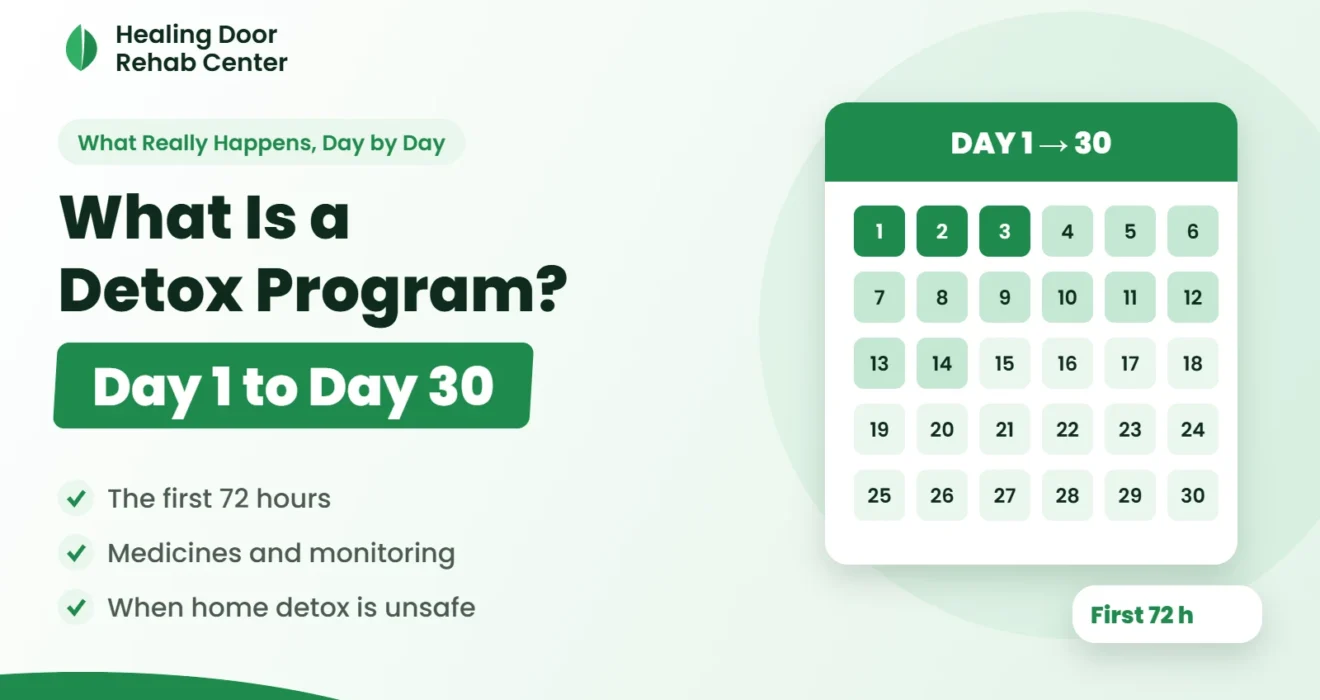
Day 1 to Day 30: what to expect
Every person is different, so treat this as a typical shape, not a promise.
Day 1: arrival. Assessment, tests, first medicines if needed, and a search of belongings so that hidden tablets or charas cannot undo the plan. Families are told what to expect and how updates will reach them.
Days 1 to 3: the closest-watched window. Alcohol and opioid symptoms build to their peak. Sleep is poor and the person may ask to leave. Scores are checked frequently and doses adjusted. For benzodiazepines, a calm start does not mean the danger has passed.
Days 4 to 7: the body starts to settle. Tremor and sickness ease, appetite returns in small steps, and doses come down. The person can manage short conversations and the first therapy sessions. With ice, this is often the lowest point for mood.
Days 8 to 14: stabilisation. Most physical withdrawal has passed (a benzodiazepine taper continues). Sleep is still broken and cravings appear around particular times, people and places. This is when hidden depression or anxiety often shows, and a psychiatric review matters.
Days 15 to 30: moving into treatment. The focus shifts from the body to behaviour: cognitive behavioural therapy, group work, family sessions and a written relapse prevention plan. Some people still have post-acute symptoms such as poor concentration, irritability and patchy sleep for weeks. That is expected, not a sign of failure.
Why mental health screening belongs inside detox
About half of people with a substance use disorder also have another mental health condition at some point. Screening during detox prevents two opposite mistakes: treating everything as withdrawal and missing real depression, bipolar disorder or psychosis, or labelling someone with a lifelong diagnosis while the drug is still in their system. A careful team watches, then confirms the diagnosis once sleep and substances have settled. When both problems are present they are treated in one plan; see dual diagnosis treatment.
What detox alone cannot do
Detox does not teach someone what to say when an old friend offers ice, what to do on the first payday at home, or how to sleep without a tablet. It does not touch trauma, family conflict or untreated depression. Its biggest hidden risk is false confidence: the person feels clear, believes the problem is solved, and leaves before the real work starts.
NIDA’s guidance is plain: medically assisted detox is only the first stage of treatment and, by itself, does little to change long-term drug use. Judge a detox program by its bridge: is the next stage booked, is therapy starting, has the family been prepared?
The overdose warning every family must hear
After days or weeks without opioids, the body loses its tolerance. A dose the person used every day before admission can now stop their breathing. The highest-risk moments are leaving detox early, the first weeks at home, and the first lapse. If someone is very drowsy, has slow or noisy breathing, blue lips or pinpoint pupils after using, call 1122 immediately and keep them on their side.
How to choose a safe detox program: 8 questions to ask
- Which doctor assesses the patient on arrival, and what tests are done?
- Who prescribes and reviews withdrawal medicines, and how often?
- Which severity scores do you use for alcohol and opioid withdrawal?
- Who is awake on site at night, and which doctor do they call?
- What happens if the patient has a seizure or becomes confused? Which hospital do you transfer to?
- Do you screen for depression, psychosis and suicidal thinking during detox?
- What therapy follows detox, and does it start without a gap?
- Is the centre registered with the Islamabad Healthcare Regulatory Authority (IHRA), and can you share the registration number so we can check it?
A clear, unhurried answer to each question is a good sign. Reluctance to talk about night cover or medicines is a warning. Our 12-point rehab checklist covers the wider choice.
Detox at Healing Door, Bani Gala
Healing Door Rehab & Psychiatric Center has treated addiction in Bani Gala, Islamabad, since 2014. Detox is led by Dr Shahid Ikram, our attending physician and addiction treatment specialist, with psychiatric review by Dr M. Iqbal Khan and therapy from our clinical psychology team. A medical team is on site 24 hours a day, and therapy and family work start while detox is still under way, so there is no gap between the two. Read more about our medical detox in Islamabad.
Ready to talk it through? One call, no obligation. Tell us the substance and the last use, and we will tell you what the first 72 hours should look like. 📞 Call: +92 314 992 2547 · 💬 WhatsApp: Start a confidential chat · Open 24/7 · Overseas families welcome
Frequently asked questions
What is a detox program in simple words?
It is medical care that helps the body through withdrawal safely when someone stops alcohol or a drug they depend on. A team assesses risk, checks vital signs, scores symptoms, gives medicine where needed and then moves the person into therapy.
How long does a detox program take?
The acute phase usually lasts 5 to 10 days for alcohol and heroin, and a few days for ice. A benzodiazepine taper can take several weeks. Cravings and poor sleep can last longer, which is why therapy continues after detox.
Can I detox at home?
Only after a doctor has assessed the risk. Alcohol and sedative withdrawal can cause seizures, and opioid withdrawal at home usually ends in relapse. If there is any doubt, get an assessment first.
What happens in the first 72 hours of detox?
Assessment and tests, regular checks of pulse, blood pressure and symptom scores, medicines adjusted to those scores, and support with fluids, food and sleep. Alcohol and opioid symptoms usually peak in this window.
Is detox painful?
It is uncomfortable, but medicines, fluids and sleep support remove much of the suffering. Severe pain or distress is a reason to review the plan, not something the patient must simply endure.
Will detox medicines make my son addicted to something else?
Not when they are prescribed for a set purpose, monitored and reduced on a plan. Ask what each medicine is for and when it will be stopped.
What if he wants to leave in the middle of detox?
That is common around day 2 or 3. Often the cause is treatable: pain, insomnia, anxiety or craving. A calm family call can help. The team should explain the risks of leaving clearly, especially seizure risk and overdose risk.
Does Healing Door accept patients from Rawalpindi, Lahore or abroad?
Yes. Families from Rawalpindi, across Punjab and Khyber Pakhtunkhwa, and overseas Pakistanis arrange admission with us. Overseas families can join assessment and family sessions by video.
Is finishing detox the end of treatment?
No. It means the body is stable enough for the real work: therapy, family sessions, relapse prevention and aftercare. See relapse prevention and aftercare.
How much does a detox program cost?
It depends on the substance, the medical risk and the length of stay, so an honest centre gives a written estimate only after assessment. Our detox cost guide explains what changes the price.
This article is general information, not medical advice for a specific person. Do not stop alcohol or sedative medicines suddenly without a doctor’s advice. In an emergency, call 1122.