
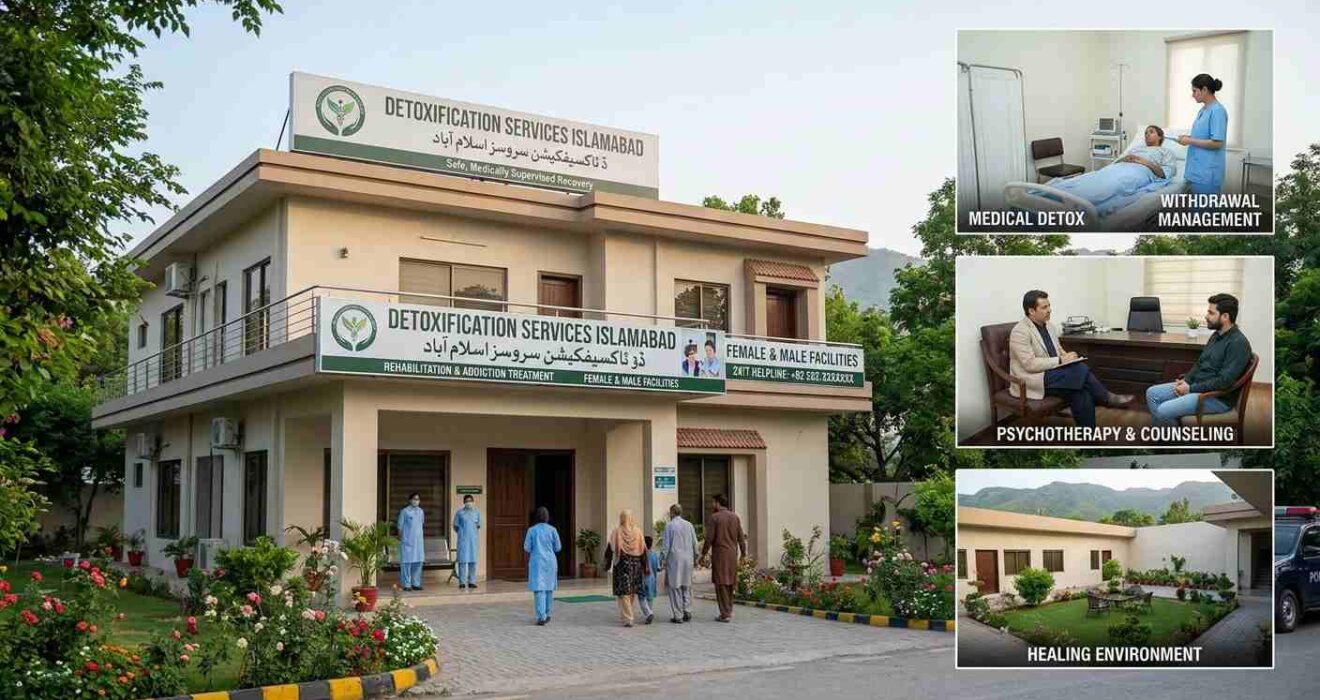
Detoxification Services Islamabad: 2026 Options & Costs
If someone in your family is going through withdrawal right now, you don’t need a lecture on addiction. You need to know where to take them tonight, what it will cost, and whether the place is actually equipped to keep them safe. Detoxification services in Islamabad range from a free 36-bed government ward in Model Town Humak to private clinics in Banigala charging six figures a month, and the gap between them isn’t just price — it’s medical capability, admission criteria, and what happens after the withdrawal symptoms stop. This guide walks through both paths honestly, including where each one fails a specific kind of patient.
What “Detoxification” Actually Covers in Islamabad
Detoxification is the medically managed process of clearing a substance from the body while controlling withdrawal symptoms, usually the first one to two weeks of a longer recovery process. It is not the same as rehabilitation. In Pakistan, this distinction matters more than it does elsewhere, because most public-sector facilities were built to detox patients, not to run the counseling and vocational programs that come after.
That gap is well documented. According to a report from the International Society of Substance Use Professionals (ISSUP), the majority of Pakistan’s existing treatment facilities — particularly public-sector ones — provide detoxification only, with no structured rehabilitation phase attached. In practice, that means a patient can walk out of a government detox ward clean but with none of the relapse-prevention support that determines whether it sticks.
Islamabad has three broad categories of provider: the federal Anti-Narcotics Force (ANF) facility, private psychiatric and addiction clinics, and hospital-based detox wards that handle acute cases, including one inside Adiala Jail in Rawalpindi that operates under the supervision of ANF’s Islamabad center. Each serves a different patient, and picking the wrong one wastes time you may not have.
Who Actually Needs Medically Supervised Detox
Not every substance requires inpatient detox, and this is where most articles on this topic get sloppy. Someone tapering off a mild benzodiazepine prescription under a doctor’s guidance is in a different category than someone withdrawing from long-term heroin or crystal meth use, where seizures, cardiac strain, and severe dehydration are real risks.
Alcohol and opioid withdrawal are the two categories where medical supervision isn’t optional — both can be life-threatening without it. Stimulant withdrawal (crystal meth, cocaine) is rarely medically dangerous but is psychologically brutal, and patients frequently underestimate how much support they need to get through the first 72 hours.
One thing beginners consistently miss: detox alone does not treat addiction. It treats physical dependence. If you’re evaluating a provider only on how well they manage withdrawal, you’re solving half the problem.
Government vs. Private Detox in Islamabad
The ANF Model Addiction Treatment and Rehabilitation Centre (MATRC)
The ANF runs a free, government-funded facility at Model Town Humak, Islamabad. As of late 2025, the center was treating around 40 patients under a structured two-month program, according to Colonel Malik Ayub Awan, the facility’s administrator, in comments to the Associated Press of Pakistan. Admission is restricted to Pakistani citizens aged 18 to 48, and every patient undergoes a full medical workup before entry — a dope test, PCR, X-ray, and bloodwork.
The catch is capacity. Reports have cited waiting lists running into the thousands for a facility with only a few dozen beds at any given time. A second, larger Model Addiction Treatment and Rehabilitation Centre is under construction in Islamabad at a cost of roughly Rs 456.38 million and was reported as 99 percent complete in a 2025–26 government progress report — a meaningful freshness signal if you’re researching this in 2026, since bed capacity in the city is about to expand.
Private Clinics and Psychiatric Facilities
Islamabad also has private addiction and psychiatric facilities such as Nishan Rehab in Banigala and Healing House Psychiatric Clinic, which combine detoxification with ongoing psychiatric care. Private providers move faster — often same-day admission — and typically offer individualized medical protocols, private rooms, and family therapy built into the program from day one.
The trade-off is cost and inconsistency in oversight. Pakistan’s private addiction-treatment sector isn’t uniformly regulated the way hospitals are, so due diligence on staffing and licensing sits with the family, not with a central authority.
| Factor | ANF Government Centre | Private Clinic |
|---|---|---|
| Cost | Free | Typically Rs 80,000–300,000+ per month (verify with provider) |
| Admission speed | Waitlist, often weeks | Usually same-day to 48 hours |
| Age eligibility | 18–48 only | Case-by-case, including minors in some facilities |
| Program length | ~2 months, structured | Varies, 2–8+ weeks |
| Aftercare | Two-year follow-up reported by ANF | Varies by clinic, often add-on |
| Privacy | Lower — shared wards | Higher — private rooms common |
What Happens During a Detox Admission
Every credible provider follows roughly the same medical sequence, even if the setting differs.
- Intake assessment — medical history, substance-use history, bloodwork, and often a psychiatric screening to rule out co-occurring conditions.
- Stabilization — the first 3 to 5 days, where withdrawal symptoms peak and medical staff manage them with supportive medication where appropriate.
- Medical monitoring — vitals checked regularly through the first one to two weeks, since complications like seizures or severe dehydration typically show up early.
- Symptom tapering — days 5 through 10 to 14, where acute symptoms fade but psychological cravings often intensify.
- Transition planning — a good facility starts this before detox ends, not after. This is the step most government facilities in Pakistan under-deliver on, per the ISSUP findings cited earlier.
For clients in a family-decision-making role — often the person actually reading this, not the patient — the transition-planning step is worth asking about explicitly before admission. If a facility can’t describe what happens in week three, that’s a gap you’ll be filling yourself.
The Real Cost of Detox in Islamabad
Public reporting on private-sector pricing in Pakistan has historically shown wide swings, with older reporting citing per-patient costs from roughly Rs 45,000 to Rs 150,000 for private treatment — figures that are now over a decade old and almost certainly understate current rates given inflation and rupee depreciation since. Treat any number you find online, including the ranges here, as a starting point for a conversation with the provider, not a quote.
Total cost of a private detox admission usually includes more than the headline daily or monthly rate:
| Cost Component | Typical Range (verify current pricing directly) |
|---|---|
| Base detox program (2–4 weeks) | Rs 80,000 – 250,000+ |
| Psychiatric consultation fees | Rs 3,000 – 10,000 per session |
| Lab work and diagnostics | Rs 5,000 – 20,000 |
| Family therapy add-on | Often bundled, sometimes billed separately |
| Extended stay beyond initial program | Billed at daily rate, can add 30–50% to total cost |
| Aftercare / outpatient follow-up | Rs 5,000 – 15,000 per month |
A 2020 Dawn investigation cited a survey finding that 99.7 percent of people seeking drug treatment in Pakistan could not afford it — a stark number, and part of why the free ANF route remains the only realistic option for most twin-cities families, waitlist or not.
Choosing Between Government and Private: A Practical Framework
Government detox (ANF) fits you if: the patient is 18–48, you can tolerate a waiting period, cost is the binding constraint, and you’re comfortable with a shared-ward setting.
Private detox fits you if: the patient needs admission within days, is outside the ANF age bracket, has a co-occurring psychiatric condition needing dedicated management, or privacy is a genuine concern — for public-facing professionals, this is often the deciding factor.
Pros of the ANF route: no cost, medically staffed, structured program, documented follow-up. Cons of the ANF route: long waitlists, strict age eligibility, limited bed capacity, less privacy.
Pros of private clinics: fast admission, individualized care, better privacy, flexible age policy. Cons of private clinics: meaningful cost, inconsistent regulation across providers, quality varies clinic to clinic.
Where the popular advice — “just go private if you can afford it” — actually breaks down is with patients under 18 or with severe co-occurring psychiatric illness. Not every private clinic in Islamabad is equipped for dual-diagnosis cases, and sending a patient with untreated psychosis or severe depression to a facility that only handles substance withdrawal can make things worse, not better. Ask directly whether the facility has a psychiatrist on staff, not just a general physician, before admission.
Mistakes That Undo a Successful Detox
The single biggest failure point isn’t the detox itself — it’s what happens in the 30 days after. Patients who leave a detox program without a rehabilitation or outpatient plan relapse at meaningfully higher rates, which is exactly the gap the ISSUP report flagged in Pakistan’s public system. A second common mistake is families treating detox as a one-time fix rather than the first step in a longer process; addiction specialists in Islamabad routinely see patients cycle through detox two or three times before committing to a full rehabilitation program with aftercare.
A third, quieter mistake: choosing a facility based on cost alone without confirming it has 24-hour medical staff on-site. For alcohol and opioid withdrawal specifically, this isn’t a comfort feature — it’s a safety requirement.
What to Do After Detox Ends
Detox resolves the physical dependency. It does not resolve the behavioral and psychological drivers of addiction, which is why the strongest outcomes come from a direct handoff into a rehabilitation program — inpatient, outpatient, or a structured 12-step or counseling framework — the moment detox concludes. If the facility you’re considering doesn’t have a clear answer for what comes after day 14, ask them to spell it out before you commit, or build that follow-on plan yourself with a separate provider.
Bookmark the cost table above before you start calling providers — most will quote a headline number and leave out the add-ons, and having a reference point speeds up an already stressful set of phone calls.
CONCLUSION
Detoxification services in Islamabad split cleanly into two paths: the free ANF Model Addiction Treatment and Rehabilitation Centre, which works well if you can wait and the patient fits the 18–48 eligibility window, and private clinics like Nishan Rehab or Healing House, which cost more but move faster and handle complex or co-occurring cases the government facility isn’t built for. Neither path is complete on its own — the decision that actually protects long-term recovery is what happens after detox, not during it. If you’re calling providers this week, ask about aftercare and psychiatric staffing before you ask about price. Recovery starts at detox, but it’s won or lost in the weeks after it.
FAQ SECTION
1. What is the difference between detox and rehab? Detox is the medical process of clearing a substance from the body and managing withdrawal, usually one to two weeks. Rehab is the longer behavioral and psychological treatment phase that follows, often eight weeks or more, and it’s the part most public facilities in Pakistan under-deliver on.
2. Is detox free in Islamabad? Yes, through the ANF Model Addiction Treatment and Rehabilitation Centre in Model Town Humak, which offers free treatment to eligible Pakistani citizens aged 18 to 48. Private clinics charge for detox, with costs varying by facility and length of stay.
3. How long does drug detox take? Acute withdrawal symptoms typically peak in the first three to five days and taper over one to two weeks, though full detox programs often run two to four weeks to include monitoring and initial stabilization before transition planning begins.
4. Can I get admitted to ANF’s rehab center immediately? Usually not. Reports have cited waiting lists in the thousands against a few dozen available beds, so admission can take weeks. Private clinics typically offer same-day or 48-hour admission if timing is critical.
5. What does private detox cost in Islamabad? Costs vary significantly by clinic and length of stay, historically ranging from tens of thousands to well over a hundred thousand rupees per month. Always confirm current pricing directly with the provider, since rates change and older published figures are outdated.
6. Is alcohol detox more dangerous than drug detox? Alcohol and opioid withdrawal both carry serious medical risk, including seizures and severe dehydration, and require supervised care. Stimulant withdrawal is rarely life-threatening but is psychologically intense and still benefits from professional support.
7. Can minors get detox treatment in Islamabad? ANF’s government facility only admits patients aged 18 to 48. Families with a minor needing treatment generally need a private clinic equipped to handle adolescent cases, and should confirm this capability before admission.
8. What happens after detox is complete? Ideally, a direct handoff into a rehabilitation program, whether inpatient, outpatient, or structured counseling. Patients who leave without a follow-on plan relapse at notably higher rates, which is the most common gap in Pakistan’s public treatment system.
9. How do I know if a detox facility is medically qualified? Confirm there is 24-hour medical staff on-site, not just a general physician on call, and ask specifically whether a psychiatrist is available for cases involving co-occurring mental health conditions. This matters most for alcohol and opioid withdrawal.
10. What should I ask a private clinic before admission? Ask about total cost including lab work and family therapy, staffing qualifications, whether they handle dual-diagnosis cases, and exactly what their aftercare plan looks like once the initial detox period ends.