Cognitive Behavioral Therapy (CBT) in Islamabad
If you are searching for a CBT therapist in Islamabad for yourself or a family member, call us any time on +92-314-9922547. The first conversation is confidential, and we will honestly tell you whether CBT is the right starting point.
CBT stands for Cognitive Behavioral Therapy. It is a structured, evidence-based form of talk therapy that helps you identify the unhelpful thoughts and behaviour patterns that keep addiction, depression and anxiety going, and replace them with healthier ways of thinking and coping. At Healing Door Rehab and Psychiatric Center in Bani Gala, Islamabad, CBT is a core part of our drug addiction treatment programmes, delivered by our psychology team and integrated with medical and psychiatric care under one roof. You can see how CBT sits alongside our other therapies in our overview of the therapeutic modalities at Healing Door.
What Is CBT? (In Simple Words)
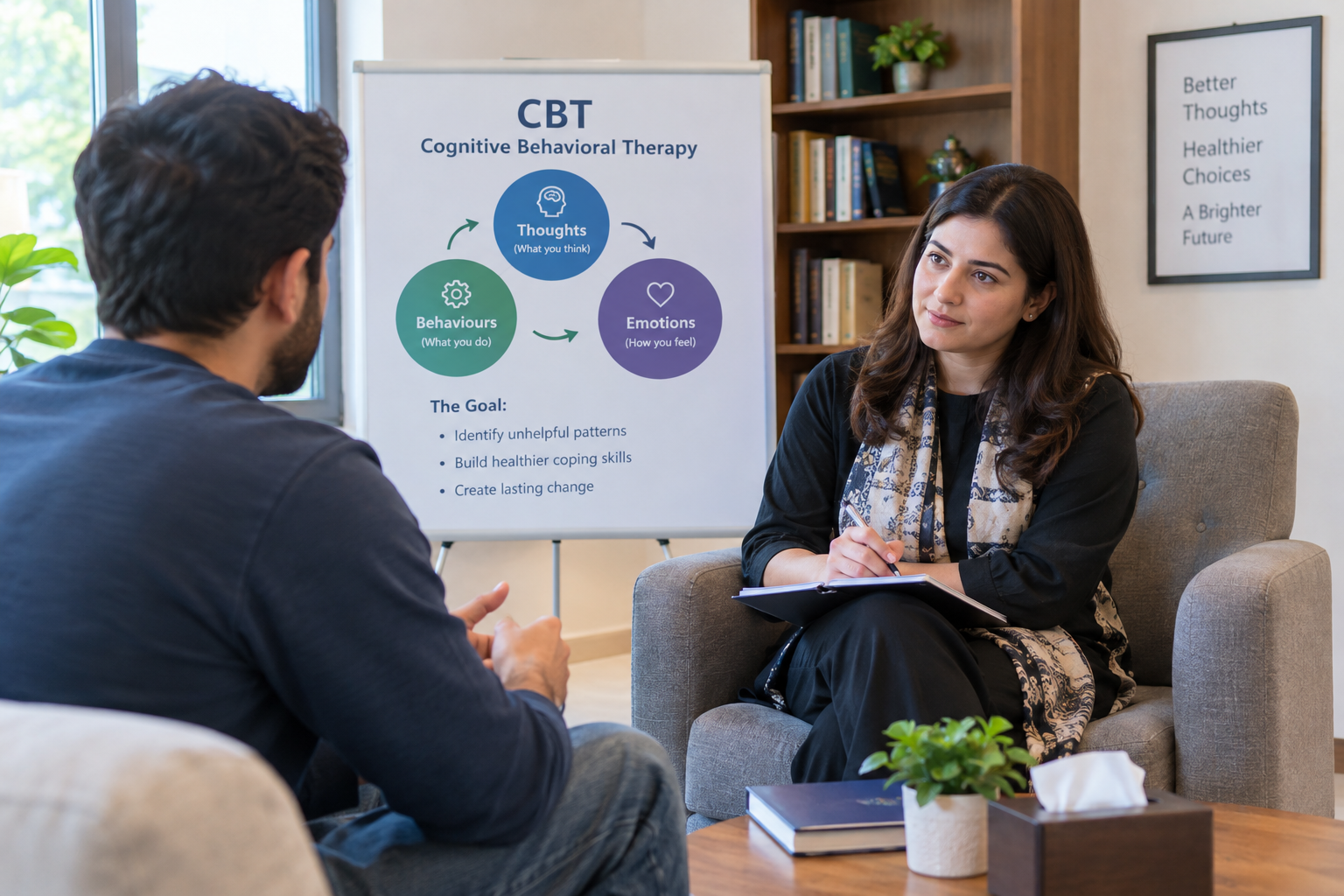
CBT is based on one practical idea, often shown as a triangle: your thoughts, your feelings and your behaviour affect each other. A painful thought (“I cannot cope without it”, “I am a burden on my family”) creates painful feelings, and those feelings push behaviour, such as using a substance, withdrawing from everyone, or giving up. The behaviour then creates more painful thoughts, and the cycle continues.
CBT breaks this cycle at the points you can actually change. In sessions, you learn to notice the thoughts that appear automatically in difficult moments, test whether they are fully true, and practise responding differently. Over time, the new responses become habits. CBT was developed by Dr. Aaron Beck in the 1960s and is today one of the most researched therapies in the world, recommended by bodies such as NICE and the American Psychological Association for addiction, depression and anxiety disorders.
Unlike open-ended counselling, CBT is structured and goal-focused. You and your therapist agree on what you are working on, each session follows a plan, and you practise small, specific skills between sessions. That structure is one reason CBT fits addiction treatment so well: recovery itself is built from daily habits.
Not sure whether CBT is the right starting point? You do not have to decide alone. Talk to our expert team or call us on +92-314-9922547 for a confidential conversation about your situation. There is no obligation, and the first guidance on the phone is free.
How CBT Works: The ABC Model
Therapists often explain CBT with the ABC model:
Activating event
Something happens. For example, an argument at home, a stressful day at work, or passing a place linked to old use.
Beliefs
Your mind interprets the event. “I have ruined everything.” “No one understands me.” “One time will not hurt.”
Consequences
The feelings and behaviour that follow: shame, anger, cravings, and possibly relapse, avoidance or panic.
Most people assume A causes C directly. CBT shows that B, the interpretation, drives the consequence, and B can be examined and changed. With practice, the work reaches the deeper level underneath these automatic thoughts: your core beliefs, the fixed conclusions formed over years (“I am helpless”, “I will always fail”), which are the reason the same painful thoughts keep returning. Changing core beliefs is slower work, and it is where lasting recovery is built. In therapy you learn to catch the belief in the moment, check the evidence for and against it, and build a more balanced belief:
“I had a bad day and I have handled bad days before. I can call my sponsor, go to a meeting, and get through tonight.”
CBT Techniques We Use at Healing Door
Your therapist selects techniques according to your assessment. The ones below are the working tools of CBT, and you will recognise them in your sessions:
Thought records
Writing down the situation, the automatic thoughts it triggered, the feeling they caused, and a more balanced alternative thought. This is the basic exercise that trains your mind to catch distortions.
Cognitive restructuring
Learning to identify cognitive distortions, the common thinking errors behind addiction and low mood: all-or-nothing thinking (“I slipped once, so I have failed completely”), catastrophising (“this craving will never end”), mind reading (“everyone thinks I am hopeless”), overgeneralisation (“I always mess everything up”) and personalisation (blaming yourself for everything). Each distortion has a practical counter-question you learn to ask.
Behavioural activation
For depression and early recovery, carefully scheduling meaningful and achievable activities so that motivation follows action, instead of waiting to “feel ready”.
Exposure work
For anxiety and trauma-linked fears, facing feared situations gradually and safely, in planned steps, so the fear loses its power.
Activity and sleep scheduling
Rebuilding a daily routine, which is one of the strongest protections against relapse.
Problem-solving training
A step-by-step method for handling real-life problems (debt, family conflict, work stress) without escaping into use.
Relapse prevention planning
Mapping your personal triggers and high-risk situations, building coping responses for cravings, and writing a concrete plan for what to do in the first five minutes of a crisis. This plan grows into the full relapse prevention programme that protects you after discharge.
Between-session practice
Short, agreed tasks after each session. CBT skills grow through practice, not only through talking.
Want to learn these skills with a specialist?
Our psychology team will assess your situation and tell you honestly whether CBT is the right place to start. The call is free and confidential.
CBT for Addiction
Addiction is maintained by learned patterns: cues and triggers, rituals, and beliefs such as “I cannot sleep without it” or “I cannot face people sober.” CBT for addiction targets exactly these patterns. In our programmes at Healing Door, CBT works alongside medical detox and psychiatric care, and it is woven into treatment for ICE addiction, heroin addiction and alcohol addiction. The same CBT framework runs through our cocaine addiction treatment, where thought patterns around confidence and performance are often central. In sessions you will map the chain that leads to use, learn urge-surfing and refusal skills, rebuild routines and relationships, and prepare a written relapse prevention plan before discharge. Families are included at planned points, because the home environment is where the new skills must work. Our group therapy programme practises many of the same skills with peers, which strengthens them.

CBT for Depression
For depression, CBT focuses on the loop between low mood, negative thinking and withdrawal. Sessions use behavioural activation to restart rewarding activity, thought records to challenge beliefs such as “nothing will change”, and problem-solving for the real difficulties feeding the low mood. CBT is a first-line, evidence-based treatment for depression and is often combined with medication where our consultant psychiatrists advise it. You can also read our guide to choosing anxiety and depression medication with psychiatric guidance.
CBT for Anxiety
For anxiety disorders, CBT identifies the worry patterns and safety behaviours (avoidance, constant reassurance-seeking, checking) that keep anxiety alive. Treatment combines thought work with gradual exposure, so you learn from direct experience that the feared outcome is unlikely or survivable, and that anxiety falls on its own when you stay. CBT is used for generalised anxiety, panic attacks, social anxiety and health anxiety, and our team will explain clearly which approach fits your assessment.
CBT also plays a supporting role in longer-term psychiatric care. In our schizophrenia treatment programme, adapted CBT helps patients understand their experiences, manage distressing symptoms and rebuild daily functioning alongside medication and family work.
CBT vs REBT: What Is the Difference?
Families often ask about REBT because both therapies work with thoughts.
Albert Ellis
REBT (Rational Emotive Behavior Therapy), developed by Albert Ellis, focuses mainly on identifying and disputing irrational beliefs and the demanding “musts” behind them (“I must be approved by everyone”).
Our core therapy
CBT is the broader modern family of therapies: it tests thoughts against evidence through structured exercises and behavioural experiments, and measures progress against agreed goals.
In practice the two overlap, and both are respectable, evidence-informed approaches. At Healing Door we deliver CBT as our core structured therapy because its session-by-session structure integrates best with addiction programmes and measurable recovery goals.
Reading about therapy is step one. Step two is a conversation. If addiction, depression or anxiety is affecting your family, call +92-314-9922547 now. Our team answers 24/7, everything you share stays confidential, and we will tell you honestly whether CBT, medical treatment, or both are the right path. You can also reach us through our contact page.
What CBT Sessions Look Like at Healing Door
Assessment first
Before therapy begins, our team completes a clinical assessment (history, current symptoms, substance use where relevant, and any psychiatric needs), so CBT is planned around your actual problems, not a template.
Agreed goals
In the first sessions you and your therapist set specific goals, for example sleeping without medication, returning to work, or handling cravings without using.
Structured weekly sessions
Sessions typically last 45 to 60 minutes. Each one reviews your practice tasks, works on one or two skills, and ends with a clear plan for the week.
A defined course
A standard CBT course is often 12 to 16 sessions, adjusted to your progress and, for inpatients, integrated into the daily programme at the center.
Family involvement
With your consent, family members join selected sessions to learn how to support recovery at home.
Review and relapse prevention
Progress is reviewed against your goals, and therapy closes with a written plan for maintaining gains, including what to do if symptoms or cravings return.
CBT is available within our residential programmes and, after assessment, as outpatient appointments for suitable patients. If you are unsure which setting fits, call +92-314-9922547 and we will guide you honestly.
Stories of Recovery
EXCELLENT Based on 236 reviews
 Posted on Google
 Habiba KhanOur experience today was very good and we are very satisfied.Posted on Google
 Kazia RumiiI visited healing door rehab center and had a really positive experience. The staff is professional, caring, and very supportive. The environment is clean, peaceful, and focused on recovery You can clearly see how much they care about their patients’ well-being. The facilities are well-maintained and the treatment approach feels thoughtful and respectful. I would definitely recommend this center to anyone looking for quality care.Posted on Google
 Muhammad NabeelWorking with Healing door rehab center HDRC was an absolute pleasure. Their team demonstrated deep expertise, professionalism, and clear communication throughout the entire process. They truly understood our specific psychological needs and delivered exceptional results. I highly recommend their services.Posted on Google
 Mamta KanwalHealing Door Rehab Center Bani Gala Islamabad is a place that truly restores hope. From day one, the professional and compassionate team treated every patient with dignity and respect no judgment, just real listening and 24/7 support that makes you feel safe. The peaceful, green location in the Bani Gala hills creates a naturally therapeutic environment away from Islamabad’s stress, while the structured program balances clinical care with group therapy, fitness, and wellness activities. What stands out most is their focus on family involvement; the staff teaches families how to communicate and support recovery the right way. Healing Door doesn’t just manage a condition,it helps people get their life back. I highly recommend visiting the center to meet the team and see the environment before deciding.Posted on Google
 AmjadHighly trained team providing outstanding support throughout the recovery journey.Posted on Google
 Zohaib AbbasiThe best care rehab centerPosted on Google
 Hamza Shahbest rehab center for schizophrenia and other psychiatric disorders. all the Best to Dr Asad Noor and his teamPosted on Google
 TANEEM ULHAQLike best hospital for drugs Best hospital for psychiatric problems Etc dase comments with 5 star ratingPosted on Google
 Aleena ZebTheir commitment to patient well-being, coupled with their attentive and friendly approach, made a significant difference in overall experience. The cleanliness, efficiency, and timely response of every staff member reflect the high standards.
Why Choose Healing Door for CBT in Islamabad?
Therapy inside a full clinical team
Your CBT therapist works with our consultant psychiatrists and medical team, so medication, detox and therapy pull in the same direction. Standalone counselling cannot offer this.
Addiction-specialist psychologists
Our psychology team treats addiction daily, not occasionally, and CBT here is built around real relapse situations our patients face in Pakistan.
Structured and measurable
Goals, session plans and progress reviews, in line with how CBT is meant to be delivered.
Family included
Planned family sessions and guidance, because recovery succeeds or fails at home.
Calm, private setting
Our Bani Gala center offers a quiet, green environment away from the triggers of city life, with full confidentiality.
24/7 admission support
Day or night, a real person answers on +92-314-9922547.
Recovery is built one skill at a time. Start today.
Admissions and guidance are available 24/7. Tell us what your family is facing and we will guide you to the right care, privately and without pressure.
How Much Does CBT Cost in Islamabad?
The cost of CBT depends on the setting: sessions inside a residential programme are part of the overall treatment plan, while outpatient sessions are charged per session after assessment. For context, public listings in Islamabad (OlaDoc, Apka Muaalij, October 2026) show individual CBT and psychology sessions commonly ranging from about PKR 1,500 to PKR 5,000 per session, with a full course often running 6 to 20 sessions depending on the condition.
What we will never do is quote your figure before understanding your case, because the right number of sessions and the right combination of care differ from person to person. Call us for a confidential assessment and a clear, written cost explanation before you decide anything. There is no charge for the initial phone guidance.
Areas We Serve
Healing Door is based in Bani Gala, Islamabad, and our patients come from across the capital, including:
Islamabad
Rawalpindi
Families travelling from
Across Pakistan and overseas
We also regularly treat patients from across Pakistan and overseas Pakistani families arranging care for a loved one.
For outpatient CBT appointments, many patients travel in from Rawalpindi and the wider Islamabad area. Call our 24/7 number: +92-314-9922547.
Frequently Asked Questions
What does CBT stand for?
CBT stands for Cognitive Behavioral Therapy. “Cognitive” refers to thoughts, “behavioral” to actions. It is a structured talk therapy that changes unhelpful thought and behaviour patterns behind addiction, depression and anxiety.
What is CBT in simple terms?
CBT teaches you to notice the thoughts that trigger painful feelings and unhelpful behaviour, check whether those thoughts are accurate, and practise healthier responses until they become habits.
How does CBT work for addiction?
It maps the chain of triggers, thoughts and cravings that leads to use, then builds specific skills for each link: handling triggers, riding out cravings, refusing offers, rebuilding routine, and planning for high-risk situations. This is why CBT is a standard part of evidence-based addiction treatment.
How many CBT sessions will I need?
A typical course is 12 to 16 sessions, but the right number depends on your assessment and progress. Your therapist will agree a plan with you and review it as you go.
Is CBT better than medication?
They do different jobs and are often strongest together. Medication can stabilise mood, sleep and cravings; CBT builds the skills that protect you long-term. At Healing Door, our psychiatrists and psychologists plan this together rather than leaving you to choose alone.
What is the difference between CBT and REBT?
REBT, by Albert Ellis, centres on disputing irrational beliefs and rigid demands. CBT is the broader, structured approach that tests thoughts with evidence and behavioural practice against agreed goals. Both work with thoughts; CBT’s session structure and measurement make it our core therapy for addiction programmes.
Can I do CBT from home or online?
Between-session practice at home is part of CBT, and follow-up sessions can sometimes be arranged remotely after an in-person assessment. Full self-help without a therapist works for mild difficulties but is not a substitute for treatment in addiction or moderate to severe depression and anxiety.
How much does CBT therapy cost in Islamabad?
It depends on whether sessions are part of a residential programme or outpatient appointments. We explain all costs in writing after a confidential assessment. The first phone guidance is free: +92-314-9922547.
Recovery starts with one honest conversation.
Whether you are seeking help for yourself or for someone you love, our team at Healing Door is here day and night. Call +92-314-9922547 or send a message through our contact page. For quick answers to common questions about admission and treatment, see our FAQs, or explore all of our treatment services.
مدد مانگنا کمزوری نہیں، ہمت ہے۔ آج ہی ہمیں کال کریں۔