
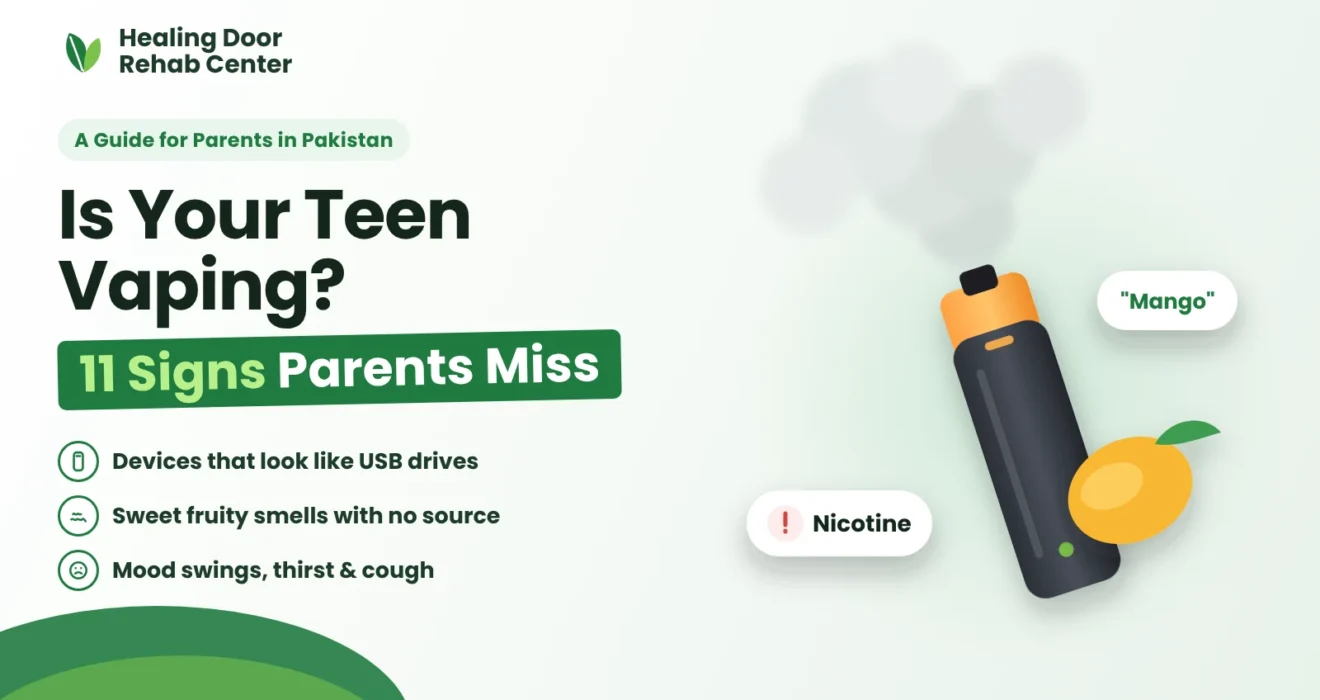
Is Your Teen Vaping? 11 Signs Pakistani Parents Miss
Your son’s room smells of mango. Odd, since there’s no mango in the house. On his desk there is something that looks like a USB drive and is charging from his laptop.
That is very likely a vape.
Vaping (using an e-cigarette) means inhaling a heated liquid that usually contains nicotine, flavouring and other chemicals. For teenagers it is not a harmless alternative to smoking. Nicotine is highly addictive, and the teenage brain is still developing until the mid-twenties. The WHO reports that in every one of its regions, children aged 13 to 15 now use e-cigarettes at higher rates than adults.
This guide is for Pakistani parents: how to spot vaping, what it does, and what to say, because the first conversation decides most of what follows.
How common is vaping among Pakistani teens?
There isn’t yet a reliable national figure for teen vaping alone. What we do know:
- A WHO-linked report says nearly 1 in 10 Pakistani teenagers aged 13 to 15 has used a tobacco or vaping product
- A Gallup Pakistan survey released in January 2026 estimated more than 1.2 million adult vape users, and noted anecdotal evidence of use among school children
- Pakistani researchers have warned that by the time the harms are fully understood, teen vaping may already be an epidemic
In our consultations, parents usually find out late. That’s not because they aren’t paying attention. Vapes are designed to go unnoticed.
11 signs your teen is vaping
- A sweet smell with no source: fruit, mint, bubblegum or “ice” flavours that disappear within seconds
- Unfamiliar gadgets: objects shaped like USB drives, pens, highlighters or small boxes, often with an LED light
- Extra chargers and USB-C cables they have no clear use for
- Small cartridges, pods or bottles of liquid in bags, pencil boxes or shoe boxes
- Increased thirst and a dry mouth. They’re drinking more water or juice
- Nosebleeds or a frequent dry cough
- Irritability or restlessness that eases after a trip to the bathroom or the roof
- More time alone in bathrooms, cars or on the rooftop
- Money they can’t account for, or pocket money running out early. Disposables are not cheap
- Brand names in chats or on their phone: words like “puffs,” “pods,” “nic salts” or flavour names
- Falling concentration or poorer sleep, sometimes with headaches when they haven’t vaped
One sign on its own proves nothing. Several together, especially signs 1, 2 and 7, are worth a calm conversation.
What vaping actually does to a teenager
| Effect | Why it matters at 13 to 19 |
|---|---|
| Nicotine addiction | A teenage brain becomes dependent faster than an adult’s. Some disposable vapes contain as much nicotine as several packs of cigarettes |
| Effects on brain development | WHO links youth e-cigarette use to effects on brain development and learning problems |
| Stronger anxiety and mood swings | Nicotine withdrawal between puffs feels like anxiety, and teens think vaping is calming them down |
| Gateway to cigarettes | Studies consistently show that young people who vape are almost 3 times more likely to start smoking cigarettes later |
| Lungs and throat | Coughing, wheezing and irritation. Long-term effects are still being studied, and that uncertainty is itself a reason for caution |
| Unknown contents | Unregulated liquids from shops or online may not match their labels. Some devices are used for cannabis or other drugs |
“Is vaping safer than cigarettes?”
For an adult smoker who switches completely, some evidence suggests vaping is less harmful than smoking. That argument does not apply to a 15-year-old who has never smoked. For a teenager, the choice isn’t vape or cigarette. It’s vape or nothing, and nothing is the safe option.
Is vaping legal for teens in Pakistan?
As of late 2026, Pakistan has no single federal vaping law in force [CONFIRM before publishing]:
- Khyber Pakhtunkhwa: a 2024 notification restricted sales to young people and banned sales within 50 metres of educational institutions (the minimum age is reported as 21 in some sources and 18 in others [CONFIRM])
- Punjab: a province-wide ban was announced in 2025 but was blocked by the Lahore High Court pending legislation. Later rules bar vape sales in school and university canteens [CONFIRM]
- Federal: an Electronic Nicotine Delivery Systems (Regulation) Bill proposing a minimum age of 18, no sales near schools and no advertising has passed a Senate committee, but has not become law [CONFIRM]
What this means for you: the law will not keep vapes out of your child’s hands. The conversation at home is what makes the difference.
How to talk to your teen about vaping: 7 steps
- Pick a calm moment, not the moment you find the vape. Anger gets denial. Wait until you’re both calm.
- Start with a question, not an accusation. “A lot of kids at your school vape. What do you think about it?” opens the door. “Are you vaping?” usually closes it.
- Listen more than you talk. You’ll learn why they do it: stress, friends, curiosity, or the flavour.
- Share facts, not scare stories. Teens can tell when they’re being exaggerated to and stop listening. The facts above are serious enough on their own.
- Separate the child from the behaviour. “I’m not angry at you. I’m worried about what nicotine does to your brain.”
- Agree on a plan together. Quit date, removing devices, what happens with friends who vape. A plan they helped make is one they’re more likely to follow.
- Check in weekly, not hourly. Constant searching of their room breaks trust. A short weekly conversation builds it.
What not to do
- Don’t take away the phone and the vape in the same moment as a punishment. They’ll associate quitting with being punished
- Don’t assume “it’s only flavour, zero nicotine.” Labels on unregulated products often can’t be trusted
- Don’t hide it from the other parent. Teens use any split between parents to keep vaping
Helping your teen quit
Most teens who vape occasionally can stop with a family plan and support at school. For a teenager who vapes daily, cravings and irritability peak in the first few days and ease over 2 to 4 weeks, similar to other forms of nicotine withdrawal.
Get professional help if:
- They have tried to stop and couldn’t
- They vape within minutes of waking up, or at night
- There are signs of anxiety, depression or self-harm (see our guide on teenage depression treatment)
- You suspect the device is being used for cannabis or other drugs (watch for the signs of drug addiction)
- They have stolen money or lied to get vapes
Healing Door’s team works with adolescents and their families together, without shaming, with a confidential assessment and a quit plan that fits school life. If the conversation at home has stalled, our family intervention programme in Islamabad can help you take the next step. You can also read about our youth addiction recovery support, or call us 24/7 at [CONFIRM phone number].
FAQs
How can I tell if my child is vaping?
Look for sweet smells with no source, USB- or pen-shaped devices, spare pods or chargers, more thirst, nosebleeds, unexplained spending and irritability that eases after time alone. Several of these together are a strong sign.
Is vaping harmful for teenagers?
Yes. Most vapes contain nicotine, which is addictive and affects a developing brain. Teens who vape are also almost 3 times more likely to start smoking cigarettes later.
Can a vape be used for drugs?
Yes. Some devices are used for cannabis oils and other substances. If behaviour changes are stronger than nicotine would explain, get a professional assessment.
What age can you buy a vape in Pakistan?
There is no single national rule yet. KP restricts sales to young people, and a federal bill proposing a minimum age of 18 has not yet become law. Check your province’s current rules.
Medical disclaimer: This article is for general information and is not a diagnosis. Speak to a qualified doctor about your child.