Rehabilitation Center in Islamabad | HDRC 2026 Guide
When someone in your family needs a rehabilitation center in Islamabad, the decision doesn’t feel like a research project. It feels like an emergency with too many options and no clear way to evaluate them.
The problem isn’t that there are no options. There are. The problem is that most rehabilitation centers in Islamabad present themselves the same way — same language, same claims, same photographs of clean rooms and smiling staff. Families end up choosing based on proximity or price because nothing else differentiates one place from another.
This guide covers what actually matters when evaluating a rehabilitation center in Islamabad, what different types of rehabilitation involve clinically, what HDRC specifically offers, and what questions to ask any facility before admission.
What “Rehabilitation Center” Actually Covers in Islamabad
Rehabilitation center is not a single category. In Islamabad, the term covers at least four distinct types of clinical need — and confusing them leads families to the wrong facility.
Drug and Alcohol Rehabilitation addresses substance dependency through medically supervised detoxification, behavioral therapy, psychiatric care where needed, and structured aftercare. This is the largest category of rehabilitation need in Islamabad and the one most families are dealing with when they search.
Psychiatric Rehabilitation supports people recovering from severe mental illness — psychosis, schizophrenia, bipolar disorder in acute phases — who need a structured residential environment alongside psychiatric medication management and therapy.
Mental Health Rehabilitation covers conditions like severe depression, PTSD, anxiety disorders, and trauma responses that have reached a point where outpatient care is insufficient and a structured residential program is clinically necessary.
Dual Diagnosis Rehabilitation treats the combination of substance use and psychiatric illness simultaneously within a single integrated program. This is the most clinically complex category and the one most rehabilitation centers in Pakistan are not properly equipped to handle.
Understanding which category applies to your situation determines which facility type is appropriate. A general rehabilitation center that treats drug dependency may not be equipped for dual diagnosis. A psychiatric hospital may not offer the addiction-specific therapy that drives long-term recovery. The category matters before the facility does.
Government vs. Private Rehabilitation Centers in Islamabad
Families frequently search for a government rehabilitation center in Islamabad or a free rehabilitation center in Islamabad — and the honest answer requires separating what exists from what people hope exists.
H3: Government Rehabilitation Options in Islamabad
Pakistan’s primary government-operated facility for drug rehabilitation is the National Institute of Rehabilitation Medicine (NIRM) under the Ministry of National Health Services. NIRM operates in Islamabad and provides inpatient services for substance use disorder. The Anti-Narcotics Force (ANF) of Pakistan also operates rehabilitation programs across the country, with some capacity in the Islamabad region.
The honest limitations of government rehabilitation in Islamabad are resource constraints. Wait times can be significant. Clinical staffing ratios are lower than private facilities. The therapeutic depth — particularly for dual diagnosis cases and aftercare planning — is typically less developed than specialist private centers. For acute emergency stabilization and for patients whose financial situation makes private care impossible, government facilities serve an important function. For sustained, outcome-focused rehabilitation with individual treatment planning, they are rarely sufficient on their own.
H3: Free Rehabilitation Centers in Islamabad
Truly free residential rehabilitation in Islamabad is extremely limited. Some charitable and religious organizations run residential programs, but clinical oversight in these settings varies significantly. For cases involving active psychiatric illness, severe dependency, or dual diagnosis, programs without qualified psychiatrists and psychologists on staff carry real clinical risk. The absence of a fee does not mean the absence of risk.
If cost is the primary barrier, the better approach is to contact a qualified facility and discuss what options exist — phased payment, reduced rates for financially constrained families, or referral to appropriate government services. HDRC’s clinical team discusses financial situations directly. Call +92-314-9922547 and have that conversation honestly. A good facility will give you an honest answer about what is possible.
What a Proper Rehabilitation Center in Islamabad Should Provide
This is the section most families need and most facility websites skip. Here is a specific checklist of what a credible rehabilitation center in Islamabad should be able to confirm before admission.
Clinical Assessment Before Treatment Begins Every patient’s treatment plan should start from a full assessment — substance history, psychiatric evaluation, physical health markers, family context. A facility that admits patients without this step is guessing at treatment rather than designing it.
Medically Supervised Detoxification For drug and alcohol rehabilitation, detox requires 24-hour medical supervision by a qualified physician. Alcohol and benzodiazepine withdrawal can be life-threatening without proper management. Any facility that handles detox without a physician on-site is not safe.
Qualified Psychiatric Staff Psychiatric illness co-occurs with addiction at high rates. A rehabilitation center without a consultant psychiatrist on staff cannot treat dual diagnosis. Ask specifically whether the facility has a psychiatrist — not a general physician, a psychiatrist.
Evidence-Based Therapeutic Approaches CBT (Cognitive Behavioral Therapy) and DBT (Dialectical Behavior Therapy) are the most clinically validated therapeutic approaches for both addiction and mental health rehabilitation. If a facility cannot name the specific therapies it uses and the credentials of its therapists, that is a warning sign.
Family Involvement Rehabilitation that treats only the patient and ignores the family system produces results that rarely last. The home environment that the patient returns to is part of the clinical picture.
Written Aftercare Plan at Discharge Leaving a rehabilitation center without a documented aftercare plan significantly increases relapse risk. The plan should name triggers, coping strategies, follow-up schedule, and emergency contacts. This is not optional — it is clinical standard.
Verifiable Accreditation Ask to see accreditation documentation. Legitimate facilities are accredited by UNODC, recognized by ANF, registered with the relevant healthcare regulatory authority. Ask for it directly. A credible facility hands it over immediately.
HDRC: Rehabilitation Center in Bani Gala, Islamabad
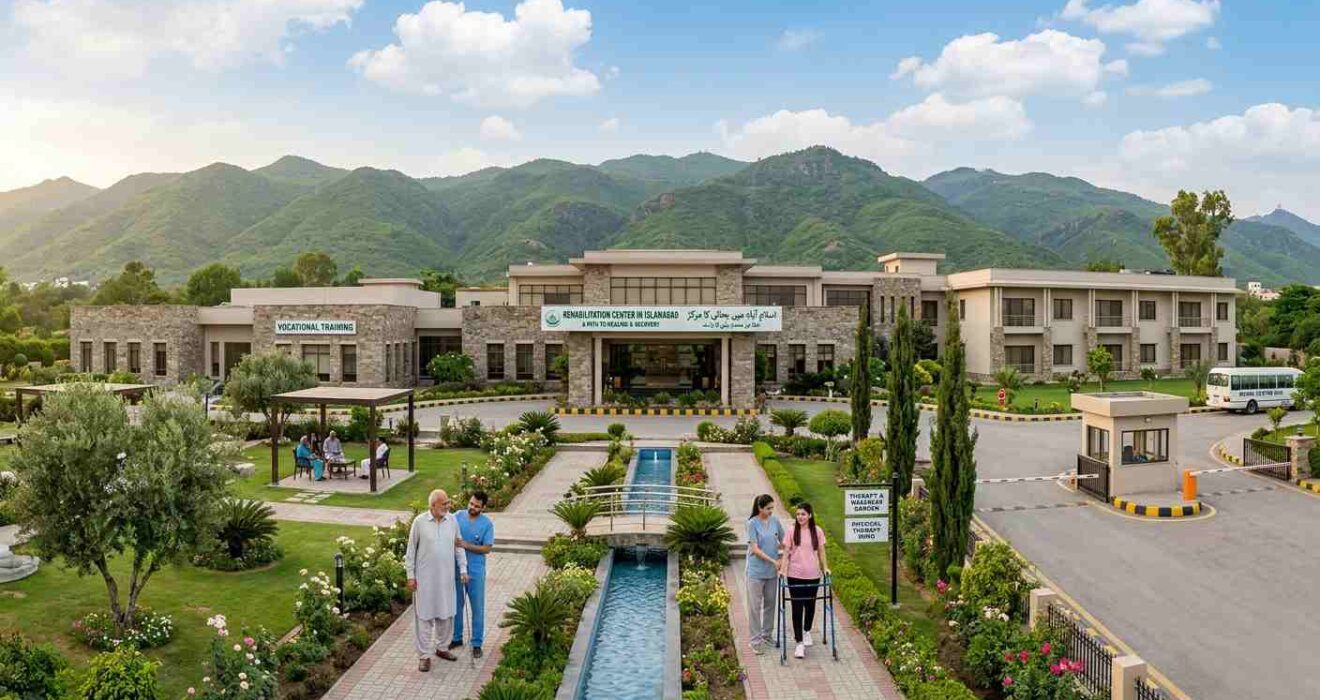
Healing Door Rehab Center (HDRC) has been operating as a rehabilitation center in Islamabad since 2014. The facility is located in Bani Gala — physically removed from the city’s density and social pressures in a way that is clinically deliberate, not just aesthetically appealing.
HDRC is UNODC-accredited, approved by IHRA Pakistan, recognized by Pakistan’s Anti-Narcotics Force, and registered with the Islamabad Healthcare Regulatory Authority. These are verifiable credentials. Ask for the documentation.
What HDRC Treats
HDRC’s program covers the full range of rehabilitation need that families in Islamabad present with:
- Drug addiction rehabilitation — heroin, ICE (crystal methamphetamine), tramadol, pregabalin, Xanax, cannabis, cocaine, prescription opioids
- Alcohol use disorder rehabilitation
- Psychiatric rehabilitation — severe depression, anxiety disorders, PTSD, bipolar disorder
- Dual diagnosis treatment — simultaneous addiction and psychiatric illness
- Mental health rehabilitation for conditions requiring residential structure
- Female rehabilitation — dedicated women-only program with appropriate privacy and female clinical staff
Pakistan’s Anti-Narcotics Force 2025 assessment identified methamphetamine as the fastest-growing addiction category in Islamabad and Rawalpindi. HDRC’s ICE rehabilitation program addresses this specifically, with psychiatric assessment integrated from day one because ICE withdrawal is primarily psychological — depression, psychosis risk, weeks of disturbed sleep — rather than primarily physical.
HDRC’s Clinical Team
Dr. Asad Ali Noor — CEO, Consultant Psychologist, and Addiction Therapist. Clinical leadership and program oversight.
Dr. Nasir Mehmood Abbasi — Medical and Addiction Specialist, Director. Leads medical management and addiction medicine.
Prof. Dr. Jan Alam — Consultant Psychiatrist and Psychotherapist. Psychiatric assessment and management including dual diagnosis cases.
Dr. M. Iqbal Khan — Consultant Psychiatrist. Medication management and psychiatric care within the integrated treatment model.
Ms. Aneela Sarfraz — Consultant Clinical Psychologist. Individual and group psychological therapy.
Ms. Ammarah Shaarif — Clinical Psychologist and Addiction Specialist. Therapeutic program delivery.
Dr. Shahid Ikram — Medical Officer. Day-to-day medical support and monitoring.
This is a full multidisciplinary team. Most rehabilitation centers in Islamabad do not have a psychiatrist on staff at all. HDRC has two consultant psychiatrists embedded within the same program that handles detox, therapy, and aftercare.
H3: HDRC’s Treatment Structure
Every admission follows the same four-phase clinical sequence:
- Full Clinical Assessment — Medical, psychiatric, and addiction evaluation before treatment planning begins. No standard template. Each patient’s history is different and the plan reflects that.
- Medically Supervised Detoxification — 24-hour medical supervision by qualified physician. Substance-specific protocols. Withdrawal management that is calibrated to the actual clinical presentation, not a standardized schedule.
- Therapeutic Rehabilitation — CBT, DBT, individual counseling, group therapy, motivational interviewing, family therapy. The therapeutic phase is not a fixed duration — it runs until the patient has the clinical foundation for sustained recovery.
- Relapse Prevention and Aftercare — Written discharge plan. Identified triggers. Coping strategies. Post-discharge follow-up schedule. HDRC remains accessible to patients and families after discharge.
Both inpatient (residential) and outpatient programs are available. Residential means the patient lives at the Bani Gala facility, removed from the environment that sustained the addiction. Outpatient means structured sessions while the patient continues living at home — appropriate only when the home environment is genuinely stable and supportive.
If you’re reading this and trying to decide whether HDRC is the right fit, the next step is a phone call. +92-314-9922547. The call is confidential, available 24 hours a day, and carries no commitment to admission. The team will tell you honestly whether HDRC is appropriate for your situation.
Mental Rehabilitation Centers in Islamabad — When Psychiatric Rehabilitation Is the Primary Need
Not every family searching for a rehabilitation center in Islamabad is dealing with addiction. Some are dealing with a family member whose psychiatric illness has reached a severity that outpatient treatment cannot manage.
Severe depression that has stopped responding to medication. A first psychotic episode that requires monitoring and stabilization in a safe environment. PTSD that has become functionally disabling. These situations require a different clinical response from addiction rehabilitation — specifically, a residential environment with 24-hour psychiatric nursing, medication management by a qualified psychiatrist, and therapeutic support for the underlying condition.
PIMS (Pakistan Institute of Medical Sciences) in G-8 and Shifa International Hospital in H-8 both operate psychiatric inpatient wards in Islamabad that handle acute psychiatric crisis and stabilization. For patients who need acute emergency psychiatric intervention, these hospital settings are the appropriate first response.
For patients who have been stabilized but need ongoing residential psychiatric rehabilitation — structured daily routine, continued therapy, safe environment for recovery — a specialist residential facility with psychiatric capability is more appropriate than a hospital ward, which is designed for acute care rather than sustained rehabilitation.
HDRC’s integrated psychiatric and rehabilitation model covers this space for patients whose psychiatric condition coexists with substance use. For purely psychiatric cases without addiction involvement, the family should discuss the specific clinical picture with a qualified psychiatrist to determine the right setting.
Choosing a Rehabilitation Center in Islamabad: Decision Framework
Before calling any facility, work through these questions:
- Is the primary issue addiction, psychiatric illness, or both (dual diagnosis)?
- Is the situation acute — requiring immediate admission and medical management — or sub-acute?
- Is the home environment safe and supportive enough to support outpatient rehabilitation, or is residential separation necessary?
- Has previous treatment been attempted? If so, what failed and why?
- Are there specific requirements around gender (female-only program), language, or religious practice that the facility needs to accommodate?
- What are the realistic financial constraints, and how does that affect the options?
Answering these questions before calling any facility makes the conversation more useful for everyone. A good facility asks them anyway. Answering them first means the intake conversation moves faster to the actual recommendation.
Conclusion
Finding the right rehabilitation center in Islamabad comes down to matching the clinical setting to the clinical need. The options range from government facilities that serve an important access function to specialist private centers that provide depth of clinical care that general settings cannot match.
Healing Door Rehab Center, operating in Bani Gala since 2014, is one of the few UNODC-accredited rehabilitation centers in Islamabad with a full multidisciplinary team that spans psychiatry, clinical psychology, and addiction medicine. The program handles drug rehabilitation, psychiatric rehabilitation, dual diagnosis, and mental health rehabilitation within a single integrated clinical model.
If you’re at the point of looking for a rehabilitation center in Islamabad, you’ve already made the hardest decision — that something needs to change. The next step is a confidential conversation with a qualified clinical team.
Call HDRC at +92-314-9922547. Available 24 hours a day, seven days a week.
The right facility doesn’t just keep someone safe for a month. It builds the foundation for a life after.
آپ اکیلے نہیں ہیں۔ ابھی رابطہ کریں۔
FAQ SECTION
Q1: What is a rehabilitation center in Islamabad and what does it treat? A rehabilitation center in Islamabad provides structured residential or outpatient treatment for drug addiction, alcohol dependency, psychiatric conditions, and dual diagnosis cases where addiction and mental illness occur together. The best facilities offer medically supervised detox, evidence-based therapy, psychiatric care, and a written aftercare plan at discharge. HDRC in Bani Gala covers all four categories within a single integrated clinical program.
Q2: Is there a free rehabilitation center in Islamabad? Truly free residential rehabilitation with qualified clinical staff is extremely limited in Islamabad. Government options through NIRM and ANF exist but have significant resource constraints. Some charitable programs operate but clinical oversight varies. If cost is a barrier, contact a qualified private facility and discuss options directly — many will work with families on financial arrangements rather than turn away someone who needs help.
Q3: What is the government rehabilitation center in Islamabad? The National Institute of Rehabilitation Medicine (NIRM) under the Ministry of National Health Services operates in Islamabad and provides government-funded rehabilitation services. The Anti-Narcotics Force also runs programs nationally. These facilities provide an important access function, particularly for acute cases and financially constrained families, but therapeutic depth and staffing ratios typically differ from specialist private facilities.
Q4: What is dual diagnosis treatment and does HDRC offer it? Dual diagnosis treatment addresses both a substance addiction and a co-occurring psychiatric condition simultaneously within a single integrated program. HDRC’s psychiatric team — including two consultant psychiatrists — manages dual diagnosis cases with combined medication management and addiction therapy. Treating only one condition while ignoring the other is one of the most reliable ways to produce a temporary result and a long-term relapse.
Q5: How long does a rehabilitation program in Islamabad take? Duration depends on the substance, severity, and whether psychiatric illness is present alongside addiction. Standard residential programs run 30, 60, or 90 days. ICE and heroin dependency typically require a minimum of 60 days for behavioral change to hold. Prescription drug cases may need shorter residential detox followed by structured outpatient therapy. HDRC confirms the timeline after the clinical assessment, not before.
Q6: Is there a female rehabilitation center in Islamabad? HDRC operates a dedicated female rehabilitation program with a women-only clinical environment, female clinical staff, and confidential admission. In Pakistan’s social context, this is a meaningful clinical provision — stigma around addiction is a genuine barrier to care for women, and a facility that treats the gender-specific clinical and cultural dimensions of rehabilitation produces better outcomes than a mixed-gender setting without specific accommodation.
Q7: What is the difference between inpatient and outpatient rehabilitation in Islamabad? Inpatient means the patient lives at the rehabilitation facility for the duration of the program, removed from the environment that sustained the addiction. Outpatient means attending structured sessions while living at home. Inpatient is appropriate when the home environment carries active relapse risk, when the addiction is moderate to severe, or when previous outpatient attempts have failed. When in doubt, inpatient is the lower-risk option.